
The setup
A homeowner up the street from a recent job asked me the question I get every week: “I heard foam attracts termites, voids termite bonds, and hides infestations. What do you think?”
It is a fair question, and termites are a real concern for anyone who owns property in Louisiana. It is also a question that carries a handful of separate sub-questions inside it, and most of the time nobody separates them out — the whole bundle just gets called “the termite thing” and used as a reason to walk away from an otherwise well-performing assembly.
So I want to work through the concerns one by one — not as a debate, and not as a sales pitch. The intent is a neutral, technical read that homeowner, architect, or pest professional can pick apart. The concerns fall into three buckets:
- The concern is true, but it is equally true of fiberglass, cellulose, radiant barrier, foam board, or no insulation at all. If a concern applies to every material, it is not really an argument against any one of them.
- The concern is a misunderstanding — usually of termite biology, or of what the industry's own inspection standards actually say.
- The concern is real, specific, and worth designing around. There is one. I will get to it.
One ground rule before I start. I am going to keep dragging fiberglass batting into the comparison, not because I have a problem with fiberglass in the right application, but because the same concerns rarely get raised about a five- to six-inch fiberglass batt covering the exact same wood, in the exact same crawlspace, with the exact same termites underneath — in fact, covering even more wood surface than an adhered layer of closed-cell foam does. When a concern lands only on one of two functionally similar assemblies, it deserves some scrutiny.
Concern 1 — “Foam attracts termites.”
It does not. Closed-cell polyurethane foam is a plastic. Termites are obligate cellulose feeders — they eat paper and wood. Foam offers them no nutritional value. The industry position is on the record:
“SPF is not known to attract nor does it provide a food source for termites.”
— 2017 Spray Foam Coalition / American Chemistry Council report (NAHB-hosted)1
What termites are attracted to is the wood behind whatever is in their way — foam, fiberglass, sheetrock, siding, or nothing. The covering is not the draw. The moist wood on the other side is.
Verdict: misunderstanding.
Concern 2 — “OK, but they will chew through the foam to get to the wood.”
Yes. They will. Formosan subterranean termites — the dominant species across the Gulf Coast — are documented to chew through non-cellulosic materials on the way to a food or water source. LSU AgCenter is direct about this:
“To reach a food or water source, the Formosan subterranean termite can chew through many non-cellulose materials such as thin sheets of soft metals, plastics, rubbers, stucco, styrene and seals on water lines.”
— LSU AgCenter, Formosan Subterranean Termite Damage & Detection (Pub. 2840)2
That list is not limited to foam. Termites will also work through or around:
- Kraft paper facing on fiberglass batts — which is a cellulosic paper product and therefore actual food.
- Sheetrock paper.
- Rigid plastic vapor barriers.
- Mortar joints and expansion-joint filler.
- PVC and rubber seals at plumbing penetrations.
- Fiberglass batts themselves — they do not eat the glass, but they burrow through it and use the batt as tunnel cover.3
Anything that stands between a termite and its meal, it will go through or around. This is a true statement about foam. It is also a true statement about every other insulation on the market, and about the interior finish materials that make up your walls. If “they will chew through it” disqualifies foam, then it also disqualifies your gypsum board, your fiberglass batts, and your kraft facing.
Verdict: true, but equally true of the alternatives.
Concern 3 — “They will bury themselves in the foam and use it as a nest.”
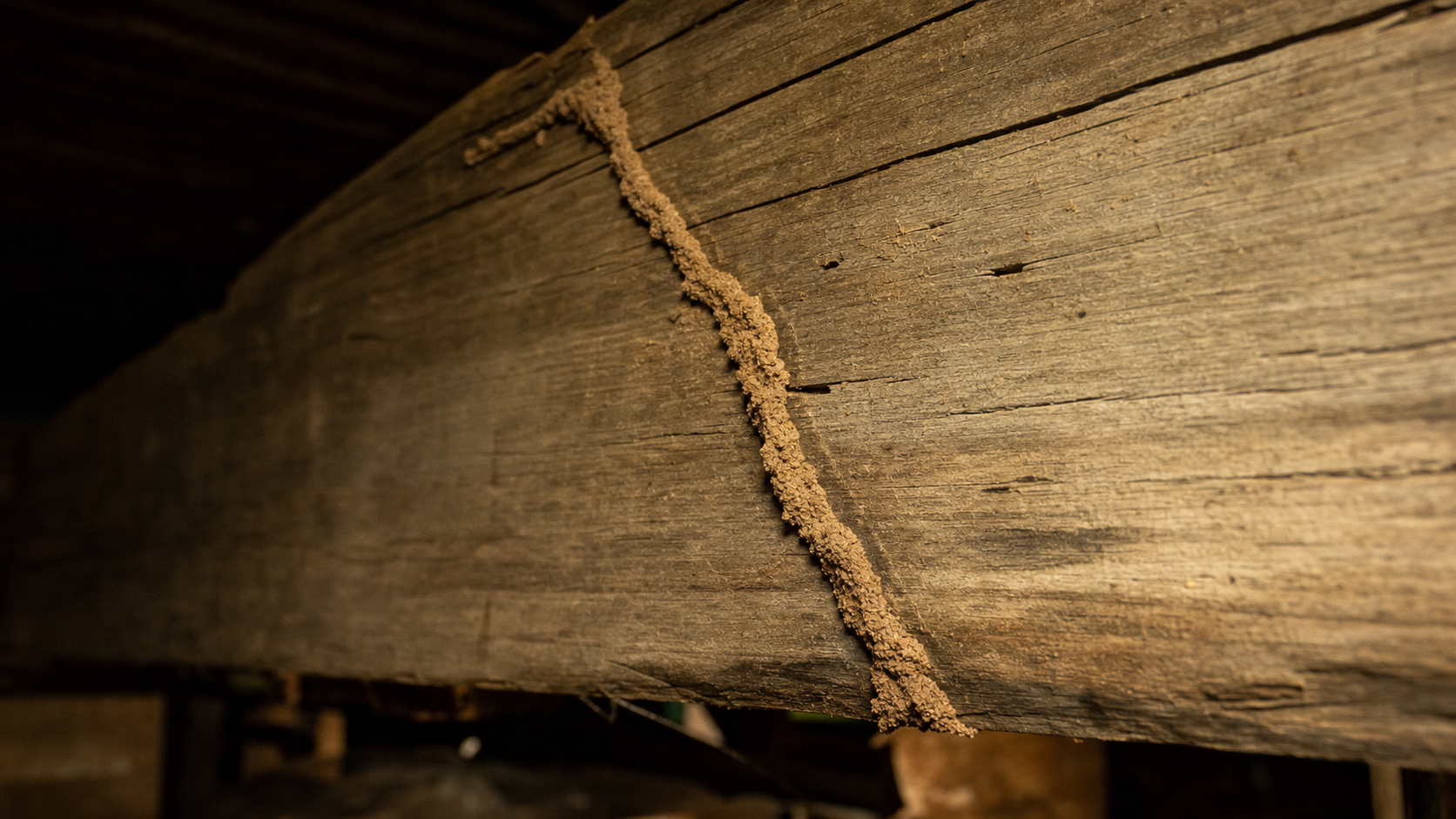
This is where language matters. Subterranean termites — the ones we design around in Louisiana — do not nest in foam. Their nest is in the soil. What they do is tunnel through the foam and use those galleries as protected highways to move between soil and their food source without desiccating.
MSU Extension has documented this exact behavior — Formosan tracks running across the back side of a closed-cell foam layer where it interfaced with the subfloor:
“Termites do not eat spray foam insulation, but they can tunnel through it, or behind it, making these already hard-to-detect pests much more difficult to detect.”
— Blake Layton, Mississippi State University Extension4
Termites will do the same thing inside a fiberglass batt. A six-inch batt is porous, airy, and gives them physical cover between joist bays that a two-inch layer of closed-cell foam adhered to the underside of the subfloor does not. And a batt hangs several inches lower than adhered foam, meaning it actually screens more wood surface from a visual inspection than the foam does.
There is a separate crawlspace concern that belongs with fiberglass, not foam. In a humid crawlspace, a batt — particularly a kraft-faced batt — collects and holds moisture against the subfloor. It sags, loses R-value, and becomes a persistent sponge against the wood it was installed to protect.
“Saturated batts hold moisture against the underside of the floor structure, keeping wood surfaces damp even during brief dry periods.”
— Crawlspace Energy Institute5
Termites need moisture to survive. A moisture-holding insulation against the framing is a conducive condition. That is a legitimate crawlspace concern — it just does not apply to closed-cell foam, which is a vapor-tight assembly.
Subterranean termites will also build mud tubes up piers, sills, and joists in plain view when there is no insulation at all. The reason we sometimes see those tubes is not the absence of insulation — it is because someone made the effort to look.
Verdict: true, but equally true of the alternatives.
Concern 4 — “They will hide between the foam and the wood.”
This is Concern 3 restated. Yes, subterraneans can run along the foam-to-subfloor interface. They can also run along the fiberglass-to-subfloor interface, and along a bare joist face with no insulation at all, and none of it will be seen unless somebody gets down there and looks.
What separates a hidden termite from a found termite is not the insulation. It is whether someone is looking, and how thoroughly.
Verdict: true, but equally true of the alternatives.
Concern 5 — “I can move a fiberglass batt aside to inspect. I cannot move the foam.”
This one is technically correct. Fiberglass batts are removable and non-structural; closed-cell foam is adhered. It is the distinction the pest industry's formal documents lean on to explain why they treat the two assemblies differently.
It is worth being precise about what actually happens in the field. A termite inspector under a 2,000-square-foot raised house is not systematically pulling every batt down joist bay by joist bay once a year — if even a single batt — restapling then resupporting as they go. Industry standards themselves acknowledge this. The NPMA-33 Wood Destroying Insect Inspection Report — the form used for FHA-insured mortgages and virtually every real-estate termite inspection in the country — is explicit:
“Based on a careful visual inspection of the readily accessible areas of the structure(s) inspected… No inspection was made in areas which required the breaking apart or into, dismantling, removal of any object, including but not limited to: moldings, floor coverings, wall coverings, siding, fixed ceilings, insulation, furniture, appliances…”
— NPMA-33 Wood Destroying Insect Inspection Report6
Read that list carefully. Insulation is called out by name, and the form itself lists spray foam insulation as one of the specific obstructions an inspector may key-out on the report. NPMA-33 is written this way not because inspectors are lazy — it is not their job to demolish someone else's house. It just means the theoretical removability of a batt and the practical reality of what a WDIR inspection covers are two very different things.
In practice, most inspections rely on perimeter spot checks near access points and on interior evidence — mud tubes on the sill you can see without moving anything, frass at door thresholds, damaged trim, swarmers by windows. That description is exactly how MSU Extension characterizes real-world WDIR work, and it is the practical reality the Georgia Department of Agriculture points at when it notes that foam impairs the visual inspection.
The question worth asking is this: if the working inspection is going to be a perimeter-visible check regardless of what is under the floor, is the theoretical removability of the fiberglass batt actually being exercised? On every batt across a 2,000-square-foot crawlspace? Or on a couple of pieces around the perimeter, enough to say it was done?
Verdict: technically correct, and the industry's strongest single argument — but it presumes an inspection method that is rarely how the WDIR plays out in practice.
Concern 6 — “Spot checks are enough.”
Sometimes they are all you get. To be fair to the pest industry: if a subterranean colony is active in a house, there is almost always visible evidence somewhere accessible — a mud tube on a pier, on the exterior of a foundation wall, on the interior of the sill plate, or damage showing from inside. Those tubes are the giveaway on foam, on fiberglass, and on bare framing alike. Confirming that activity is present is the same job regardless of insulation type — or of no insulation at all.
The real limitation is not that spot checks miss everything. It is that once activity is confirmed, spot checks alone cannot tell you how far it has spread. That is the point I want to return to below.
Verdict: partially true. Real limitation — but it is a limitation of the inspection method, not of the insulation.
Concern 7 — “What about drywood or Formosan termites — the ones that don't need soil?”
Two different concerns get tangled here.
Drywood termites are real, but they are a small share of what we deal with in Louisiana. Industry figures put drywood at roughly 5% of the state's termite damage; subterraneans — including Formosans — account for the rest. Drywoods colonize wood entirely above grade, but their colonies are smaller and slower than subterraneans, and they are more localized.
Formosans are subterraneans that happen to be extremely aggressive, and they deserve a specific mention because New Orleans is Formosan country. A few points that are worth internalizing:
- LSU AgCenter documents that Formosans have the largest colonies of any termite in North America and that workers forage as far as 100 yards from the main nest.7
- Louisiana loses approximately $500 million per year to Formosan damage, roughly $300 million of it in the New Orleans area.8
- The largest Formosan colony ever documented in the United States — roughly 70 million termites, about 600 pounds of biomass — was found under a public library in Algiers, Louisiana.9
- Formosans establish aerial (above-ground) satellite colonies when they can secure a hidden moisture source, and they build carton nests out of a chewed-wood-and-saliva material that acts as a moisture-retaining sponge.
That regional risk is why our detailing standard down here should be stricter than what you would see in the Carolinas. But it does not change the underlying logic. Formosans still need moisture, they still leave visible tracks and shelter tubes, and their aerial-colony risk is driven by hidden water more than by which insulation is in the assembly.
Verdict: true, and it raises the standard. Does not change the argument — it sharpens the moisture-management side of it.
Concern 8 — The one that is actually valid
Here is the concern that survives every honest look:
Once termite activity is confirmed, closed-cell foam makes it harder to know how far the activity has spread.
That is the real one. Not attraction. Not harborage. Not chewing through. Not spot checks. Those all apply to every insulation and to no insulation. This one is different, and it is what the code, the pest industry, and the extension services are actually pointing at.
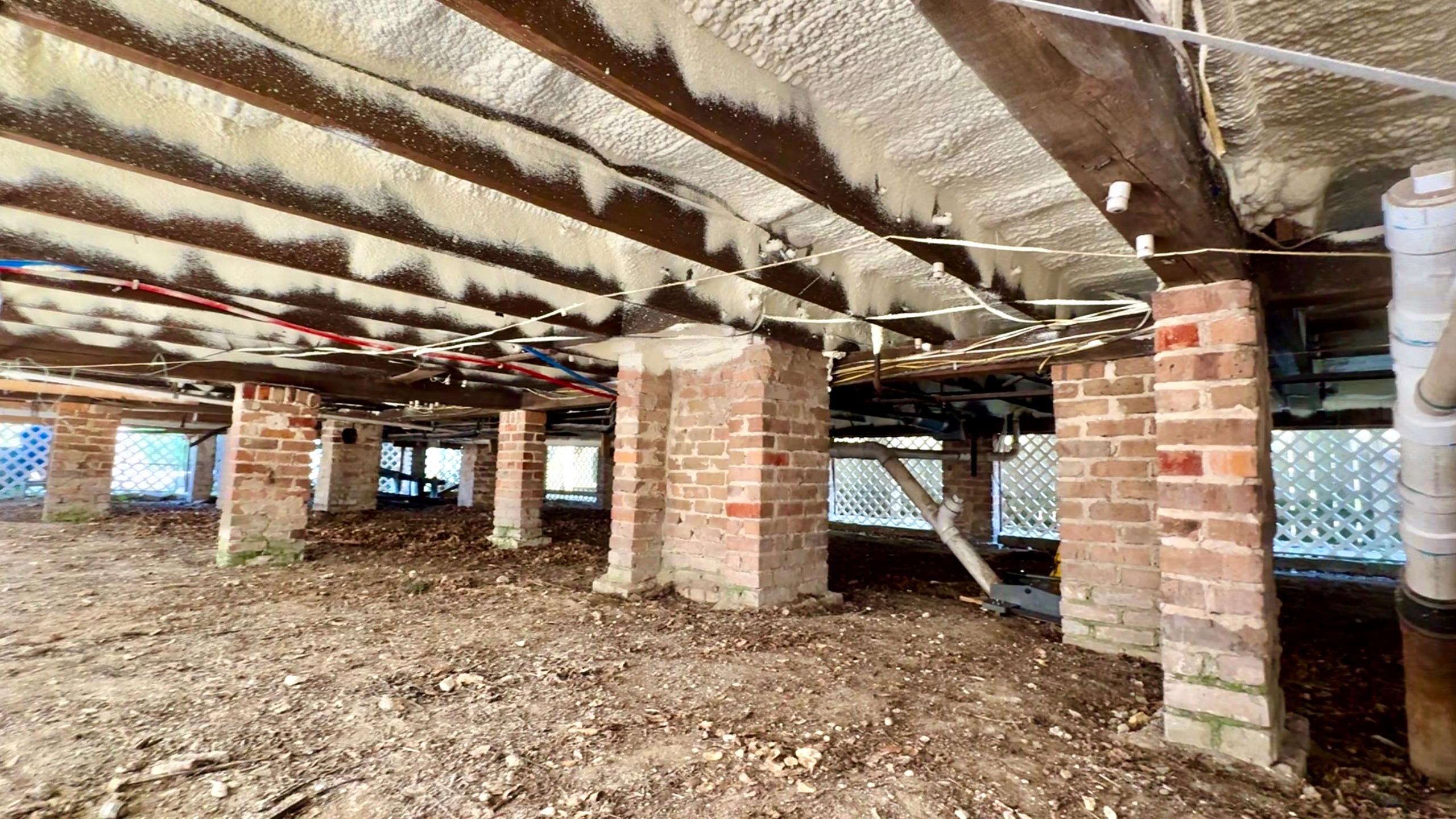
When a pest technician sees a mud tube on the sill or damage from inside the house, the next question is how far did they go? With bare framing, that answer comes from a flashlight and a probe. With a fiberglass batt, an inspector can lift a section aside — at least in theory. With adhered closed-cell foam, the wood at the foam-to-subfloor interface is not readily accessible.
The reframe worth internalizing: closed-cell foam feels hard to the hand, but a utility blade or oscillating saw parts it cleanly. If an inspector or pest tech needs a look at a specific joist bay, opening a targeted window in the foam and re-detailing it afterward is a controlled operation, not a demolition. After all, a confirmed infected wall cavity in a sheetrocked, painted, and finished interior wall requires a controlled operation too — cut, inspect, treat, patch — and nobody argues that sheetrock disqualifies the wall assembly. That said, no inspector is going to open windows across every joist bay in a full crawlspace as part of a routine WDIR, and that is exactly what the code and the industry documents recognize.
The concern is codified. Three sources speak to it directly:
- The 2021 International Residential Code, Section R318.4, requires a six-inch termite inspection gap in foam plastic along the top of the foundation wall and sill plate in crawlspace applications. Section R318.5 requires a continuous six-inch inspection strip centered along the sill plate where foam is applied.10
- The Georgia Department of Agriculture flags the same concern in Notice 18-04, its formal pest-industry advisory.11
- Mississippi State University Extension names the mechanism directly.4
“Polystyrene spray foam insulation impairs the ability of pest management inspectors from performing a visual inspection for evidence of a pest infestation, intrusion or damage. Pest Management companies typically include language in their contracts that the installation of products that prevent visual inspection may negatively affect or void a termite warranty.”
— Georgia Department of Agriculture, Notice 18-041116
Those are serious sources and they are pointing at a real thing. The fair answer to them is not to pretend the concern does not exist. It is to detail the assembly so the concern is answered on the drawing.
How a knowledgeable, experienced contractor details for it
The concern is real and codified, so the detail set below is the standard I would expect any competent Gulf-South installer to build to. This is not marketing language; it is the working checklist.
- Perimeter inspection band. A continuous, unfoamed six-inch strip at the top of the foundation wall and sill plate perimeter — the R318.5 strip. That strip is a permanent, visible surface for any inspector to read mud tubes without cutting or moving anything.
- Coordinate before the job, not after. If the home is under an active termite bond, the pest management contractor gets called before the sprayer arrives. Any specific detail requirements they have — inspection windows, thickness limits, bond-preserving language — get put in writing up front. Voided bonds after the fact are almost always a coordination failure, not a foam failure.
- Address moisture first. Above-ground colonies are a moisture problem, not a foam problem. Vapor barrier, drainage, gutter and downspout function, and humidity management belong inside the same scope of work as the insulation — not bolted on later. The SPFA report's moisture checklist (grade the landscape, functioning gutters and downspouts, repair leaks, dehumidify the crawlspace, keep vegetation off vents, maintain an eighteen-inch soil-to-untreated-wood gap) is a good starting document to review with a homeowner.
- Treat before you seal. A soil termiticide barrier is a thin chemical film applied to soil and structural interfaces. Once closed-cell foam is sprayed over a stem wall, sill plate, or rim joist, that barrier is no longer reachable, refreshable, or reapplicable without cutting the foam back. Best practice is to confirm the termite treatment is current and effective before encapsulation begins — not after. Bait stations placed outside the foundation perimeter remain accessible and are a good complementary defense.
- Match inspection cadence to the threat. The default cadence written into most termite bonds and WDIR programs is annual. In Formosan territory, more frequent inspections are the reasonable overlay. A mature Formosan colony can consume roughly thirteen ounces of wood a day — about 400 grams — and independent industry calculations put a full-strength colony at a foot of a 2×4 in a matter of days, not months. That is the pace an annual inspection is racing.
What it comes down to
If you strip the noise out of the termite conversation, this is what you are left with. Foam does not attract termites. Foam does not feed termites. Termites can and do move through fiberglass and through empty joist bays with the same result they achieve through foam. What foam does uniquely is remove the option of non-destructive inspection of the wood directly behind it — and the code answers that with an inspection gap and an inspection strip.
Every other concern in the standard list either applies to every insulation on the market — in some cases even more so than to closed-cell foam — or is a misunderstanding of termite biology. This is not to say pest professionals are wrong to raise these questions. It is to say that when a concern applies equally to every material, it is not really an argument about the material.
What it might really be an argument about, quietly, is inspection depth. How thorough is the visual? Is it perimeter-only, or joist-by-joist? Is it annual, or semiannual in Formosan country? Does it include a moisture read of the crawlspace, or only a termite read? These are worthwhile questions on a foamed house, on a batted house, and on a house with no crawlspace insulation at all.
There is no glamour in a photograph of a bare crawlspace joist bay eaten hollow, and no viral post in the story of a fiberglass batt that hid a decade of moisture damage against the subfloor. There is a lot of engagement, though, in a close-up of foam with termite tracks running across it. That asymmetry deserves a moment of honesty: millions of homes across the Gulf South have been treated or tented for termites, and the vast majority of them have never had a lick of spray foam anywhere. Termites were a homeowner concern in Louisiana for a hundred years before spray polyurethane was invented, and they will be a concern for a hundred years after the foam-versus-fiberglass argument is over.
The insulation choice is a variable. The inspection is the constant. Pick the assembly that gives you the building-science performance you are paying for, detail it to preserve the inspection access the code and the industry ask for, and then actually inspect it, on a real schedule, with a real methodology.
Everything else is oral tradition.
If your pest company is telling you they will cancel your bond over foam
This is the follow-up question I get most often, and it is the one worth answering directly rather than in the abstract. If you are reading this because your termite guy has already said he will drop the bond if you spray foam under the floor, here is the honest picture and the practical path.
Yes — contractually, in most cases he can.
Standard termite service agreements include a structural-alteration clause. Once you install something that prevents the visual inspection the contract is written around, most agreements give the pest management company the right to void the warranty.
“Generally, termite contracts allow firms to void warranties if a structure has been altered in a way that prevents inspections and treatments.”
— Cliff Slaten, founding partner, Slaten Law (Montgomery, AL), quoted in Pest Control Technology, “Foam: Friend or Foe?”12
But it is company-by-company, not universal.
The same PCT trade-industry article that established the legal basis for cancellations also documents the flip side. A number of established firms — including operators here in the New Orleans market — will keep a customer under warranty when the foam applicator provides code-compliant inspection access and the pest company is looped in ahead of time. I am compiling a list of local Louisiana pest management contractors who have told me directly that they will write or maintain a bond on a properly detailed foamed home, and I will add their names to this page as I confirm them.
The Spray Foam Coalition — the foam industry's national trade group — takes the same position from the opposite direction:
“Spray foam insulation and termite bonds can coexist. However, spray foam insulation must always be installed in compliance with local building codes. In areas with heavy termite activity, this may involve specialized requirements such as inspection strips at the base of the crawl space or basement walls, removable insulation on the rim joist… The Spray Foam Coalition recommends consulting your pest management professional before altering insulation in a crawl space or basement.”
— Spray Foam Coalition, Termite Inspections and Spray Foam Insulation15
Both trade groups — the pest side and the foam side — end up in the same place: notify the pest company first, install to a code-compliant inspection gap, and coordinate treatment ahead of the spray. When cancellations happen, it is almost always because someone skipped one of those steps.
What to actually do
If your current pest guy has already told you he will cancel, here is the sequence I would run, in order.
- Get the position in writing. Ask your pest company for their cancellation stance in an email or on letterhead, and ask them to identify the specific clause of your service agreement that permits it. This is not confrontational — it is documentation for your file, for the next pest company you talk to, and, if it ever comes to it, for your insurance carrier.
- Ask them what detail set they will accept. Some companies will keep the bond if the foam is stopped short of the sill plate and the rim joist remains inspectable — that is the R318.4/R318.5 detail set the code already asks for. If they will accept that, the problem is solved on the drawing. If they refuse any detail set, that tells you they are out regardless of how the assembly is built. That is useful information.
- Get a second and third quote — before the foam goes on. Call two or three other pest management companies in your area. Tell them up front that closed-cell foam is going under the floor with a code-compliant inspection gap, and ask whether they will write a new bond or transfer an existing one on that assembly. In the New Orleans market, the local independents tend to be more willing than the national chains to work with a properly detailed foamed home. This is not marketing folklore — it is documented in the same PCT industry survey referenced above.
- Ask about a retreat-only bond as a middle ground. Some pest companies will not issue a full repair bond on a foamed structure but will issue a retreat-only bond that keeps you covered for treatment without covering repair costs. That is a real middle ground the pest industry's own insurance advisors recommend. It is worth asking about by name.12
- Sequence the treatment correctly. Whichever company writes the bond will almost certainly want to treat first — a soil termiticide barrier at the foundation perimeter, a borate wood pretreatment on the exposed subfloor and joists, a monitoring/bait station perimeter, or some combination — before the foam goes on. Once the foam is sprayed, none of those chemical barriers can be refreshed without cutting the foam back. This is the reason coordination matters more than the material choice.
- Read your existing service agreement carefully. The clause your pest company will cite is usually titled something like structural alterations, modifications to premises, or conditions affecting inspection. Older agreements sometimes contain weaker language than newer ones. If the clause is ambiguous or absent, you have a stronger position than the pest company may be presenting. If the clause is clear, you at least understand the ground you are actually on.
The risk to keep in mind
Homeowner's insurance policies almost universally exclude termite damage as a preventable maintenance issue. Losing your bond and going uncovered in Formosan country is a material risk. The goal here is not to force your current pest company to change its mind. It is to make sure your house has a bond from someone — either the current company under revised terms, or a competing pest management contractor who will write it. Coordinating the assembly properly, up front, is how you keep that option open.
References
- Spray Polyurethane Foam Alliance & American Chemistry Council. Spray Foam Insulation & Termites (2017), NAHB-hosted industry report. Direct source for the SPF-is-not-a-food-source language. Link
- LSU AgCenter. Formosan Subterranean Termite: Damage and Detection, Publication 2840. Source for the “chew through many non-cellulose materials” quotation and Formosan biology in Louisiana. Link
- NAHB / SPFA (2017), same report. Documents subterranean movement through and behind fiberglass batts and use of kraft facing as a cellulose food source. Link
- Layton, B. Spray Foam Insulation and Termites, Mississippi State University Extension, Bug's Eye View, Vol. 8 No. 27 (2022). Source for the tunneling-through-or-behind-foam language. Link
- Crawlspace Energy Institute — structural repair methods. Source for the saturated-batt moisture-holding characterization. Link
- NPMA-33 Wood Destroying Insect Inspection Report (HUD-hosted). The industry-standard WDIR form used for FHA-insured mortgages; defines “readily accessible” and lists insulation and spray foam as inspection obstructions. Link
- LSU AgCenter. Formosan subterranean termite guidance — foraging distance, colony scale, biology. Link
- LSU AgCenter and Louisiana state-published Formosan damage figures for Louisiana and the New Orleans metro. Link
- USDA Formosan Subterranean Termite research; Algiers Regional Library colony documentation. Link
- 2021 International Residential Code, Sections R318.4 and R318.5 — foam plastic termite inspection gap and inspection strip requirements in crawlspace applications. Link
- Georgia Department of Agriculture, Structural Pest Division, Notice 18-04, Spray Foam Insulation & Pest Management. Source for the direct “impairs the ability of pest management inspectors” language and warranty voidance framing. Link
- Nagro, A. Foam: Friend or Foe? Pest Control Technology (2019). Industry deep-dive documenting cancellation patterns, named-firm positions (Cook's, Gregory, Island, ALL, Wayne's, National Exterminating), attorney and insurance-industry opinion (Slaten Law, Baker Insurance), and the retreat-only-bond alternative. Link
- National Pest Management Association. Consumer Alert: Spray Foam Insulation and Other Structural Alterations. Link
- Louisiana Department of Agriculture & Forestry, Structural Pest Control Commission — regulatory framework and inspection standards (LAC Title 7 Part XXV). Link
- Spray Foam Coalition. Termite Inspections and Spray Foam Insulation. Foam-industry trade group's official coexistence position. Link
SPFA/ACC, Spray Foam Insulation & Termites (2017), p. 2 — direct industry-position statement.↩︎
LSU AgCenter Pub. 2840 — authoritative Louisiana-specific Formosan biology reference.↩︎
Kraft-faced fiberglass batts contain cellulose; termites will consume the facing and burrow through the glass fiber matrix to reach framing.↩︎
MSU Extension, Bug's Eye View, Vol. 8 No. 27 — the foam-tunneling-and-detection language.↩︎
Crawlspace Energy Institute — saturated batt moisture retention against subfloor.↩︎
NPMA-33 defines wood-destroying insect inspections as visual, non-destructive, and limited to readily accessible areas; explicitly names insulation and spray foam as inspection obstructions.↩︎
LSU AgCenter Formosan guidance — colony scale and foraging range.↩︎
State and university figures — Louisiana Formosan damage estimates.↩︎
USDA and LSU AgCenter — Algiers Regional Library colony documentation.↩︎
2021 IRC R318.4 and R318.5 — foam plastic protection and termite inspection strip requirements, adopted in Louisiana with modifications.↩︎
Georgia Department of Agriculture, Notice 18-04 — formal pest-industry advisory on spray foam.↩︎
Pest Control Technology, Foam: Friend or Foe? (2019) — legal opinion (Slaten Law), insurance-industry opinion (Baker Insurance) on retreat-only bonds, and named-firm cancellation/coexistence patterns.↩︎
NPMA official consumer alert — spray foam insulation and other structural alterations.↩︎
Louisiana Department of Agriculture & Forestry, Structural Pest Control Commission — visual inspection and licensing regulatory framework.↩︎
Spray Foam Coalition — coexistence position, code-compliant inspection strip requirement.↩︎
A note on Notice 18-04's terminology. The notice's own background section identifies the material at issue as Polyurethane Spray Foam Insulation (PSFI) — a two-component isocyanate-and-polyol resin sprayed in place — and then uses polystyrene spray foam insulation in the operative paragraph while retaining the PSFI abbreviation. Nothing in the notice describes rigid foam board (EPS or XPS 4×8 sheets) or a rigid-board installation method; every mechanism it discusses is sprayed-in-place two-component polyurethane. The internal inconsistency reads as a drafting error rather than a deliberate scope change: the regulatory intent is spray-applied foam plastic in crawlspace applications, which is the assembly discussed throughout this article.↩︎