Why this matters — briefly
Insulation is rated by a number. A batt has an R-value printed on the paper. A can of foam has one on the label. A blown attic gets one stamped on the certificate the installer staples to the framing. The homeowner sees that number, the code official signs off on that number, and the utility rebate is written against that number.1
That number was measured in a dry laboratory, at a controlled mean temperature, with no air movement across the specimen. It is a real number. It is also not the number your wall delivers on a humid August afternoon in New Orleans, or a wet January morning in Baton Rouge, or any other day the assembly is doing what buildings actually do — moving air, moving vapor, and swinging through temperature gradients that lab tests were never designed to represent.23
This is the first piece in a three-part series on effective R-value. It answers one question: what happens, physically, when moisture enters an insulated cavity? The answer isn't a static penalty. It's a feedback loop that gets worse the longer it runs. A companion piece examines why the workmanship standard that grades insulation installations has no procedure to measure any of this. A third piece walks through the assemblies where the loop actually kills buildings — kraft-faced batts in 1920s weatherboard walls, fiberglass-wrapped ducts in a vented crawlspace, supply lines sweating through their jackets in a 130 °F Gulf South attic.
What follows is the mechanism. Once you can see it running, the rest of the series has somewhere to stand.
Section 1 — Labeled R-value is not field R-value
1.1 What ASTM actually measures
The R-value on every insulation product sold in the United States traces back to one of two ASTM test methods: ASTM C177 (guarded hot plate) or ASTM C518 (heat flow meter). Both are steady-state methods. Both hold the specimen between two plates at a fixed mean temperature — typically 75 °F — with a fixed temperature differential, in a controlled-humidity chamber, and measure the heat flux required to sustain that gradient once everything has equilibrated.45
These methods are excellent at what they do. They compare products, they generate reproducible numbers, and they let a homeowner meaningfully choose between R-13 and R-15 batts at the store. What they do not do — and what the standards themselves acknowledge — is represent an assembly in service. ASTM C177's own scope contains a caveat that moisture content within the specimen produces "transient behavior" that violates the steady-state assumption the method depends on.4 The number on the bag is a benchmark for a dry material in a dry lab. It is not a warranty of performance in a wet wall.
1.2 What the wall actually experiences
A wall in service is never in steady state. It experiences a solar-driven surface temperature swing of 60 °F or more between shaded morning and sun-loaded afternoon. It sees interior temperature swings driven by HVAC cycling, occupant activity, and thermostat setbacks. It sees pressure differentials from wind, stack effect, exhaust fans, and duct leakage — every one of which drives air through the assembly rather than merely around it. And it sees a vapor pressure gradient that reverses direction seasonally in most climates and reverses direction daily in some Gulf South conditions.6
Each of those variables affects the assembly's effective thermal resistance. None of them exist in a C177 hot-plate rig. The right mental model is that the label R-value is a ceiling — a best-case number the assembly can approach when everything else is right, and can fall well beneath when anything is wrong.3
Section 2 — The physics of the wet state
2.1 Water conducts heat. Air doesn't.
Every low-density insulation on the market works the same way. It doesn't stop heat — it traps still air, and still air is the actual insulator. Fiberglass batts, cellulose, mineral wool, open-cell spray foam: all of them are structural matrices whose job is to immobilize air pockets so those pockets can't move heat by convection.7
The relevant number is thermal conductivity, symbolized k, measured in W/(m·K). Lower is better — a lower k means a material resists heat flow more effectively. Still air has a k of approximately 0.025 W/(m·K). Liquid water has a k of approximately 0.6 W/(m·K).8
| Substance in the insulation matrix | Thermal conductivity k, W/(m·K) |
|---|---|
| Still air (the intended fill) | ~0.025 |
| Water vapor | ~0.018–0.025 (varies with RH and temperature) |
| Liquid water | ~0.6 |
| Ice | ~2.2 |
Water is roughly 24 times more conductive than the air it displaces. When vapor condenses onto a fiber inside a batt of fiberglass, the pore volume that was contributing R-value now contains a substance that is actively subverting it. You have not merely lost some insulation. You have installed a small, distributed thermal bridge.9
The bulk numbers make the point sharper. Research summarized by the Insulation Institute and building-science literature indicates that a moisture content of roughly 12 % by volume can drive fiberglass thermal conductivity up by around 300 % — an effective R-value drop of about two-thirds.1011 Studies of hygrothermal effects in low-density insulations have found measurable conductivity increases from elevated relative humidity alone, before any bulk condensation is visible.12
None of this shows up on the bag.
2.2 The two ways vapor arrives — and they are not equal
Water vapor enters an assembly by two mechanisms, and treating them as equivalent is one of the most persistent errors in how buildings are designed.
Diffusion is the movement of individual water molecules through a solid material along a vapor-pressure gradient. It is slow. It is driven by permeance, which is a material property. Painted gypsum board, kraft facing, latex primer, plywood sheathing — each has a measurable permeance rating, and diffusion through those materials is quantifiable and, honestly, usually not the main problem.13
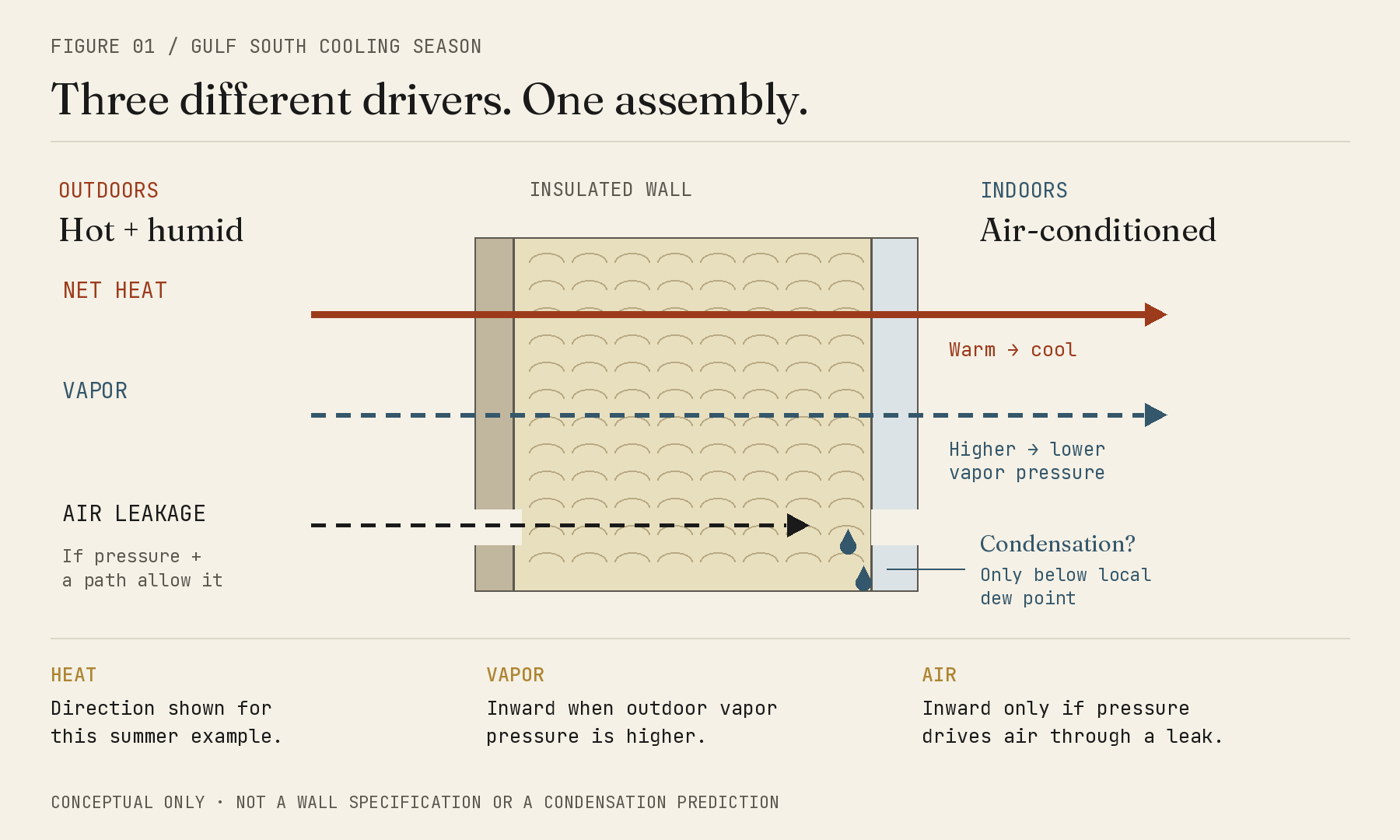
Air transport is the movement of vapor riding on bulk airflow through a hole. It is fast. It is driven by pressure differential and hole size, and it does not care what the surrounding material's permeance is because the airstream is going around the material, not through it. Building Science Corporation and the Canadian NRC have documented that air-transported moisture typically dominates diffusion by two orders of magnitude — roughly 100:1 — as a mechanism for moving water into building assemblies.1415
This ratio has consequences. It means that a wall with a properly installed vapor retarder and a single small air-leakage path is still, in practice, an air-leakage-dominated moisture problem. It means that fussing over paint permeance while ignoring the top plate penetrations, the can lights, the electrical boxes, and the drywall-to-framing joints is fussing over the wrong variable. And it means that any credible conversation about effective R-value has to start with air control, not vapor control.16
2.3 Dew point isn't a window problem — it happens inside the cavity
Every technician has seen dew point form on a cold beer glass or a cold supply-air register. The physics is boring on a visible surface: vapor-laden air meets a surface below its dew-point temperature, and the vapor condenses into liquid.17
The physics is not boring inside an insulated cavity. When vapor rides an airstream into a wall, an attic floor, or a crawlspace joist bay, it will find some surface below its dew point somewhere in the assembly. In a heating climate, that surface is on the exterior side — the back of the sheathing, the interior face of the siding, the cold-side face of the batt. In a cooling climate, that surface is on the interior side — the back of the drywall behind an air-conditioned interior wall, an interior-side kraft face, the cold jacket of a supply duct running through a 130 °F attic, the sheet-metal wall of an air handler in a garage.1819
This is called interstitial condensation — condensation that forms inside the assembly rather than on a visible surface — and it is one of the least-observed and most-consequential moisture events in residential construction. It can accumulate for years without leaving a stain. It can rot a bottom plate before the homeowner notices anything more than a room that feels muggier than the thermostat says it should.20
Section 3 — The feedback loop: why the loss compounds
If the story ended at "wet insulation has a lower R-value," we would be discussing a one-time penalty. It doesn't end there. The story compounds — and the compounding is the reason moisture problems are so hard to catch early and so expensive to fix late.
The mechanism runs in four phases.
Phase I — Intrusion
Vapor enters the cavity. In a Gulf Coast summer, that usually means humid exterior air riding an inward pressure differential — a bath fan running against a closed door, a supply-duct leak pressurizing a wall cavity, wind-driven infiltration on a shaded elevation, or the persistent inward vapor drive from a sun-warmed wet cladding after an afternoon storm.21 The airstream carries far more vapor than diffusion alone could deliver in the same window of time. Some of that vapor meets a fiber, a paper facing, a sheet-metal duct, or a drywall back-face that is below its dew-point temperature. It condenses.
Phase II — The thermal shift
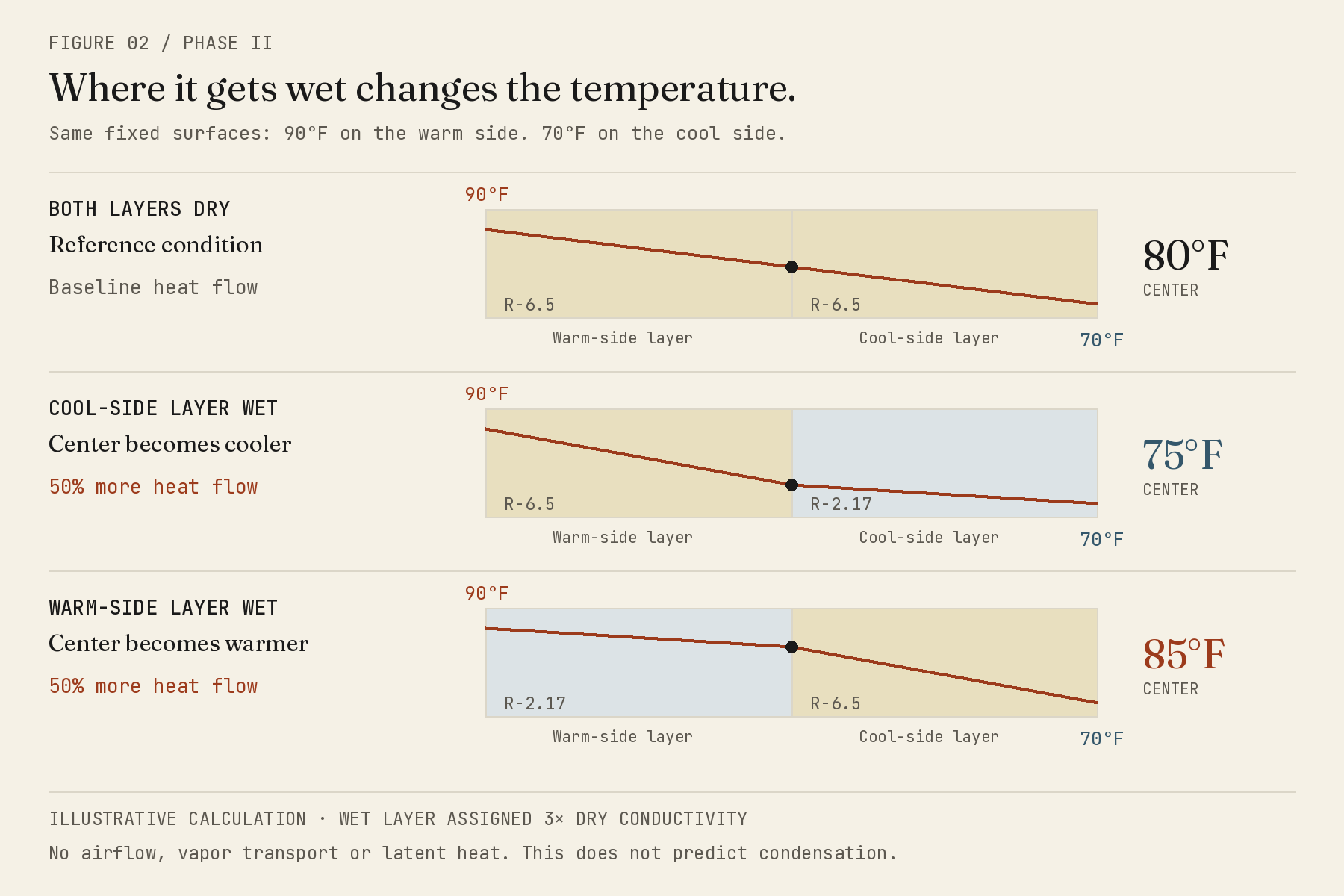
Here is where the failure becomes self-reinforcing. Liquid water is now sitting inside the pore structure of the insulation, and that pore structure just picked up a thermal-conductivity boost of roughly 24×. The affected zone conducts heat more effectively than the surrounding dry insulation. Heat now flows across it faster.
The immediate consequence is that the temperature profile through the assembly changes. In a cooling-season Gulf Coast assembly, "colder" moves inward from the cool interior — the drywall back-face, the interior-side kraft paper, the interior-side face of the batt — because the wet zone has become a thermal shortcut. Interior heat leaks outward through it more efficiently; exterior heat presses inward more efficiently; and the specific location where the assembly first drops below the incoming vapor's dew point shifts as a result.22
Phase III — Expansion of the wet zone
The dew-point plane has moved. Surfaces that were previously above dew point are now below it. New surfaces begin condensing. The wet zone grows.
Meanwhile, the original wet zone hasn't stopped condensing. The temperature differential across its now-more-conductive body is larger, meaning more heat is being pushed across it, meaning more vapor arriving at that plane finds a colder condensing surface than before, meaning more water accumulates. The loop feeds itself. This is what building scientists mean when they refer to a thermal slide: the first wetting event doesn't just reduce R-value at a point — it recruits neighboring regions of the assembly into the same failure mode.23
Phase IV — Saturation and drainage
Eventually the matrix cannot hold more water. Capillary spaces are full, fibers are coated, condensed droplets coalesce. At that point the insulation is no longer performing as an insulator — it is a thermal bridge with structural loading. Water begins to drain by gravity, pooling at bottom plates, at bath-fan boot penetrations, at duct-boot sheet-metal seams, at the low corners of joist bays. Rot, corrosion, and mold have the material and moisture conditions they need to advance.24
By the time a homeowner or an HVAC technician calls about the symptom — a musty room, a bulging drywall seam, a ceiling stain, an HVAC coil corrosion complaint — the loop has typically been running for one or more full cooling seasons. The insulation "looks fine" from the attic hatch. The R-value on the certificate has not changed. The wall has, quietly, lost most of the thermal resistance it was specified to deliver.
Section 4 — Why fiberglass is disproportionately exposed to this loop
Fiberglass gets singled out in a lot of building-science writing, and it's worth being precise about why. Fiberglass is not "bad" insulation. Installed correctly, in a well-air-sealed assembly, with continuous air-control layers on the sides that matter, and in an assembly whose vapor and drying strategy fits the climate, fiberglass performs to its label and lasts decades.
The problem is that fiberglass is the least self-limiting of the common insulations when any of those conditions is violated. Three properties compound to make it so:25
- It is highly air-permeable. A batt of fiberglass does very little to stop air moving through it, so it cannot compensate for a discontinuous air barrier on either face. Air riding a pressure differential across the cavity carries its vapor load straight into the fiber matrix rather than being stopped at a boundary.
- It is not hygroscopic. Unlike cellulose or wood-fiber insulation, fiberglass does not buffer moisture. Water that arrives stays as liquid on fiber surfaces, where its effect on k is maximal, rather than being distributed as bound moisture throughout the material at a much smaller thermal penalty.
- Its performance is exquisitely sensitive to workmanship. Voids, compression, wind-washing at the top of an attic, gaps at the back of the cavity — every one of these reduces performance further, and every one of them tends to coincide with the same regions where air leakage is highest.
Closed-cell spray foam sits at the opposite end of this spectrum: it is its own air barrier, its own vapor retarder, and largely impermeable to bulk water. Dense-pack cellulose falls in the middle — air-restrictive by virtue of density, hygroscopic by chemistry, and forgiving of small imperfections. Open-cell foam is closer to fiberglass on air permeability but adds significant self-adhesion to the framing.2627
This is not an argument that fiberglass should not be used. It is an argument that fiberglass places more of the assembly's thermal performance in the hands of the rest of the wall — the air-control layer, the vapor-management strategy, the workmanship of the drywall crew, the presence or absence of a can light penetrating the ceiling. A rigorous installation grade covers some of this. It does not, and cannot, cover all of it. That is the subject of the next piece in this series.
Section 5 — Aggravators: what makes the loop run harder
Two conditions dramatically shorten the timeline from Phase I to Phase IV. Both are extremely common in Gulf South residential construction.
5.1 Thermal bridges and metal interfaces
Any high-conductivity material embedded in or adjacent to insulation becomes the first surface to reach dew-point temperature — because it's the fastest path for heat to leave. Steel studs, metal duct jackets, sheet-metal boot flanges, HVAC line-set copper, and the metal skin of an air handler are all "condensation nucleation sites" when the surrounding air is vapor-loaded.28
Fiberglass in contact with a cold metal surface wets at the interface immediately. That local wetting then accelerates the loop at that specific point — the wet fiber further cools the adjacent metal, which draws more condensation, which further wets the fiber. In a Gulf South attic with a poorly insulated supply duct, this is the mechanism by which a jacket of R-8 fiberglass wrap arrives at Phase IV in a single summer.
5.2 Mechanical drivers vs. passive drivers
Building science often treats stack effect, wind pressure, and buoyancy as the drivers of infiltration. In modern Gulf South homes, they are outmatched by mechanical drivers. A leaky return-side duct running through a vented crawlspace can generate more sustained house-to-crawl pressure differential than any winter stack effect ever will. An oversized short-cycling AC leaves the house at 65–70 % RH between cycles, meaning every cool interior surface is a candidate condensing surface for hours per day. Bath fans, kitchen exhaust, and dryer vents each drive air and vapor through leakage paths whose existence the design never accounted for.2930
Mechanical drivers matter here because they are directional and sustained. Stack effect reverses seasonally and daily. Return-side duct leakage does not. It runs whenever the AC runs, which in Gulf South cooling season is many hours per day for months on end. Any moisture-driven feedback loop it initiates has runway to compound.
Section 6 — What this means in practice
Three things follow directly from the physics, and each of them contradicts a piece of received homeowner wisdom.
First, the number on the bag is a ceiling, not a floor. Effective R-value in a real assembly is always less than the labeled R-value, sometimes much less. This is not a defect in the product. It is a consequence of testing insulations under conditions that don't match how they're used, which is unavoidable — a lab that could reproduce every field variable would no longer be a lab.2
Second, air sealing is not a supporting act to insulation. It is a prerequisite. The 100:1 dominance of air-transported moisture over diffusion means that even a nominally correct vapor strategy cannot compensate for an uncontrolled air path. The single most valuable dollar spent on a Gulf South cavity is the dollar that seals the top plate, the can light, the electrical box, the plumbing chase, and the duct boot — before insulation is installed, not after.16
Third, the feedback loop means that "we added more insulation" is not a durable fix if the moisture pathway hasn't been closed. The added R-value is being installed into the same failing loop. It may buy a season. It rarely buys a decade.
What actually protects effective R-value is not more R on the bag. It is continuous air control aligned with the insulation layer, plus a moisture-tolerant material in the assemblies most exposed to the loop — attic supply ducts, crawlspace ducts, exterior walls of historic homes with no WRB, air handlers in unconditioned space. Those specific assemblies are the subject of the third piece in this series.
Frequently asked questions
Does the R-value on the bag change when insulation gets wet?
No. The labeled R-value is a static test result and never changes. What changes is the effective R-value delivered by the assembly in service, which can be dramatically lower. This is the reason a house can be built exactly to code, on paper, and still perform far below the code's intent.
How much does moisture actually reduce R-value?
The exact number depends on the insulation material, the moisture content, and the mechanism of wetting. Published research summarized by the Insulation Institute suggests that ~12 % moisture content by volume can raise fiberglass thermal conductivity by around 300 %, cutting effective R-value by roughly two-thirds. Elevated relative humidity alone — with no visible condensation — can measurably reduce performance before any liquid water is present.
Is this really a feedback loop, or is it a one-time penalty?
It is a feedback loop. Once condensation forms inside the assembly, the wetted zone conducts heat more effectively, which shifts the temperature profile, which recruits new surfaces into the condensing zone. The loss compounds as long as the vapor source and pressure differential continue.
Does this apply to closed-cell spray foam?
Closed-cell foam is largely immune to the feedback-loop mechanism because it is its own air barrier, its own vapor retarder, and impermeable to bulk water. That is not the same as saying it is immune to every failure mode — poor detailing, inadequate substrate preparation, and adhesion failures still occur. But the specific loop described in this article is a fiberglass and open-cell dominated phenomenon.
Why is this a bigger problem on the Gulf Coast than up north?
Two reasons. First, cooling season is our long season, and outdoor dew points sit in the 74–78 °F range for months, which means the vapor drive is inward and persistent. Second, cool interior surfaces — the back of drywall, the jacket of a supply duct, the interior side of a kraft face — become condensing surfaces whenever humid air can reach them, which in most existing homes it can. The Northern equivalent runs for a single heating season and reverses direction in spring. Ours runs for six months and rarely fully reverses.
What is the "next piece" this article keeps referring to?
This is Part 1 of a three-part series on effective R-value. Part 2 examines why the ANSI/RESNET/ICC 301 installation-grading system, the accepted North American standard for judging insulation installations, has no procedure to account for the feedback loop described here. Part 3 walks through the specific assemblies where the loop actually kills buildings in the Gulf South.
Coming next in this series
This article is Part 1 of three.
- Part 2 — The RESNET Blind Spot: Why ANSI/RESNET/ICC 301 grades workmanship, not performance, and what its inspector procedure cannot see.
- Part 3 — Thirty Quarts Through a Dime: Kraft-faced batts in weatherboard walls, fiberglass duct wrap in vented crawlspaces, and supply lines sweating through their jackets in a Gulf South attic. Where the loop actually kills buildings.
Sources & further reading
- ASTM International. C177-19: Standard Test Method for Steady-State Heat Flux Measurements and Thermal Transmission Properties by Means of the Guarded-Hot-Plate Apparatus. Link
- ASTM International. C518: Standard Test Method for Steady-State Thermal Transmission Properties by Means of the Heat Flow Meter Apparatus. Overview
- Building Science Corporation. BSD-011: Thermal Control in Buildings. Link
- Building Science Corporation. BSD-163: Controlling Cold-Weather Condensation Using Insulation. Link
- Insulation Institute (NAIMA). Moisture Control in Your Home. Link
- Insulation Institute (NAIMA). Moisture Control: Utilizing Vapor Retarders. Link
- Energy Vanguard. Does Fiberglass Attic Insulation Really Lose R-Value? Link
- Building Science Corporation. BSI-138: Vapor Barriers, Vapor Retarders, Air Barriers. Link
- NHBC Foundation. Interstitial condensation. Link
- Purdue University / IHPBC Conference. The Effect of Moisture on Thermal Conductivity of Fiberglass Insulation. PDF
- Whole Building Design Guide (WBDG). HVAC System Design for Humid Climates. Link
- Building Science Corporation. BSD-107: Understanding Ventilation in Hot-Humid Climates. Link
- Florida Solar Energy Center. Moisture Control in Hot, Humid Climates. Publications index
2021 International Energy Conservation Code, Table R402.1.2 (prescriptive R-value requirements) and R402.1.5 (labeling requirements for installed insulation).↩︎
Building Science Corporation, BSD-011: Thermal Control in Buildings.↩︎
Energy Vanguard, "Does Fiberglass Attic Insulation Really Lose R-Value?" — discussion of Oak Ridge National Laboratory field research on convective loop effects in vented attics.↩︎
ASTM International, C177-19: Standard Test Method for Steady-State Heat Flux Measurements and Thermal Transmission Properties by Means of the Guarded-Hot-Plate Apparatus. Scope and limitations sections.↩︎
ASTM International, C518-21: Standard Test Method for Steady-State Thermal Transmission Properties by Means of the Heat Flow Meter Apparatus.↩︎
Building Science Corporation, BSD-107: Understanding Ventilation in Hot-Humid Climates.↩︎
Insulation Institute (NAIMA), How Insulation Works — technical reference on the still-air principle in low-density insulations.↩︎
Standard thermal conductivity values for still air and water at ~20 °C, drawn from CRC Handbook of Chemistry and Physics and cross-referenced with ASHRAE Handbook — Fundamentals.↩︎
Armacell Engineering Bulletin, Moisture Ingress Reduces Insulation Effectiveness. Discusses the mechanism by which liquid water in an insulation pore structure functions as a distributed thermal bridge.↩︎
Purdue University / International High Performance Buildings Conference proceedings, The Effect of Moisture on Thermal Conductivity of Fiberglass Insulation.↩︎
Insulation Institute (NAIMA), Moisture Control in Your Home — homeowner-facing summary of the same underlying research.↩︎
ScienceDirect / hygrothermal performance literature on cellulose fiber and low-density mineral insulations — measurable conductivity increases from RH exposure absent bulk condensation.↩︎
Building Science Corporation, BSI-138: Vapor Barriers, Vapor Retarders, Air Barriers.↩︎
Quirouette, R. L., The Difference Between a Vapor Barrier and an Air Barrier, Institute for Research in Construction, National Research Council of Canada — the foundational study documenting the ~100:1 dominance of air-transported moisture over diffusion.↩︎
Insulation Institute (NAIMA), Moisture Control: Utilizing Vapor Retarders — restatement of the air-vs-diffusion transport ratio in current industry guidance.↩︎
GreenBuildingAdvisor, Which Is the Priority: Air-Sealing or Insulation?↩︎
ASHRAE Handbook — Fundamentals, Chapter 1: Psychrometrics.↩︎
Building Science Corporation, BSD-163: Controlling Cold-Weather Condensation Using Insulation.↩︎
Florida Solar Energy Center, moisture-control research on cooling-dominated climates and inward vapor drive.↩︎
NHBC Foundation, Interstitial Condensation — technical guidance on hidden in-cavity condensation and its detection.↩︎
Building Science Corporation, BSD-014: Air Flow Control in Buildings.↩︎
NHBC Foundation guidance on interstitial condensation dew-point migration under changing thermal profiles.↩︎
Building Science Corporation, BSD-163, discussion of progressive wetting in cold-climate assemblies; the same mechanism applies in reverse in cooling-dominated climates.↩︎
Lstiburek, J. W., RR-0208: Mold — Causes, Health Effects and Clean-up. Building Science Corporation research report.↩︎
Energy Vanguard, "Does Fiberglass Attic Insulation Really Lose R-Value?" — discussion of air permeability, workmanship sensitivity, and non-hygroscopic behavior.↩︎
Building Science Corporation, GM-2101: Guide for Building Conditioned Unvented Attics.↩︎
Building Science Corporation, BSD-102: Understanding Attic Ventilation — comparative discussion of foam and cellulose behavior in attic assemblies.↩︎
Metal Builder Magazine, Managing Thermal Bridging in Light-Gauge Steel Framing: Insulation and Moisture Strategies.↩︎
ACEEE Summer Study proceedings, Cummings, Tooley & Moyer, Unplanned Impacts on Houses by Powered Attic Ventilators — quantification of mechanical drivers of infiltration and their moisture consequences.↩︎
GreenBuildingAdvisor, What's So Wrong About Oversizing HVAC? — practitioner discussion of short-cycling and elevated indoor RH.↩︎