You know the day. Mid-April, seventy-eight degrees, not a cloud. Every window in the house is open, the air conditioner has been off since Tuesday, and nobody misses it. Somebody says we ought to live like this year round.
Then around eight in the evening the house quietly turns on you. Nothing dramatic — the sheets stop feeling cool, your shirt won't let go of your back, the kitchen smells more like the kitchen than it did. It reads as warmer. It is not warmer. It is a good ten degrees cooler than it was at three o'clock, and it is still falling. So you stand there mildly annoyed at a house that was perfect four hours ago, and eventually somebody gets up, closes the windows, and puts the thermostat back where it was. And it helps. And nobody can quite say why.
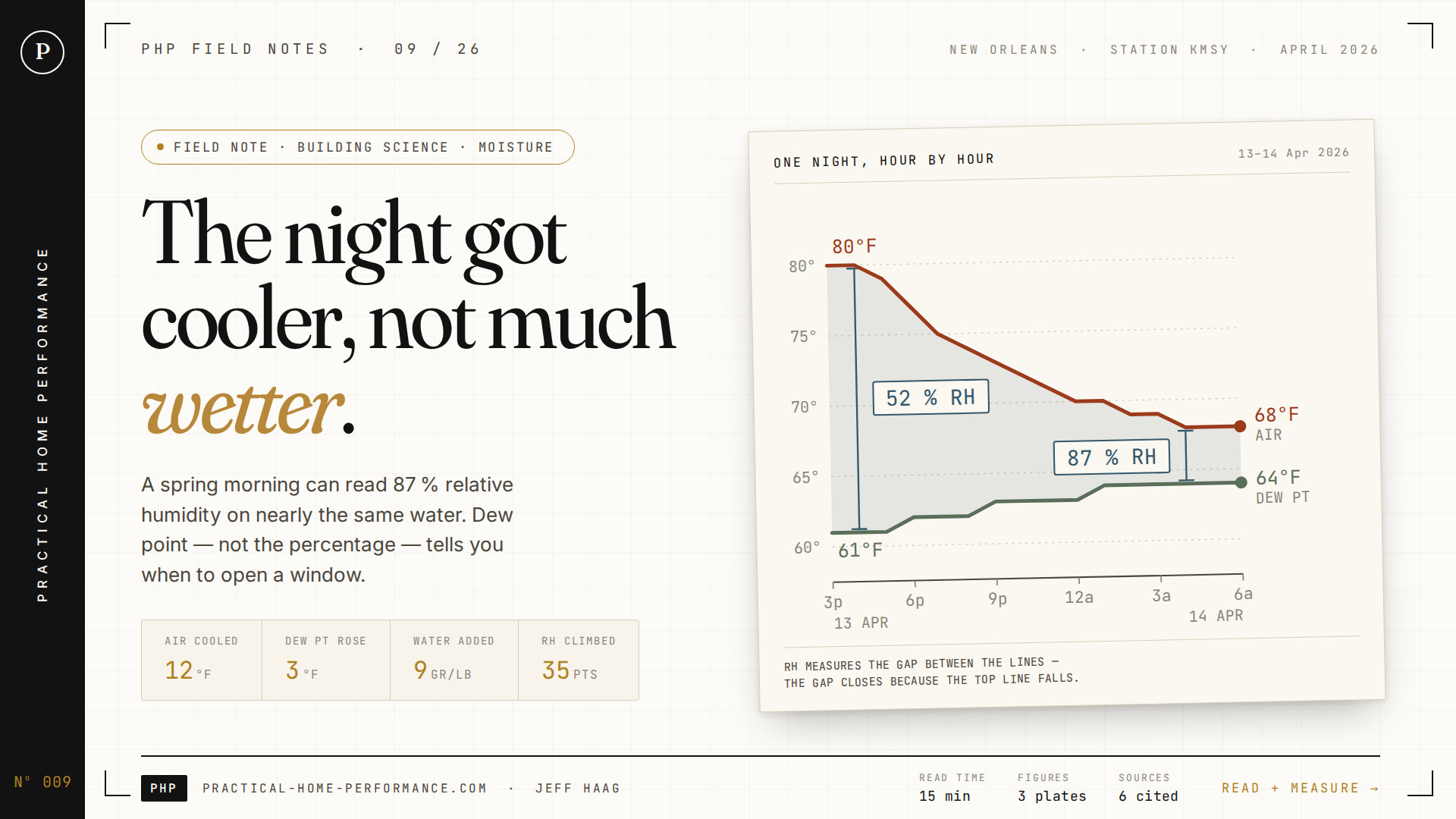
That evening is the whole subject of this article. On a good April afternoon in New Orleans the air outside is 80 °F and 52 % relative humidity. Fifteen hours later, at six the next morning, it reads 68 °F and 87 %. Almost none of that change is water arriving. Almost all of it is the thermometer falling. The distinction matters, because those two readings call for opposite decisions about whether to open a window — and the explanation most of us were taught points to the wrong one.
The short version
Between 3 PM on 13 April 2026 and 6 AM the next morning, at the New Orleans airport weather station:
- The temperature fell 12 °F, from 80 °F to 68 °F.
- Relative humidity climbed 35 points, from 52 % to 87 %.
- The dew point rose 3 °F, from 61 °F to 64 °F.
Read them in that order and the story nearly writes itself. The temperature moved a lot. The percentage moved enormously. And the dew point — the only one of the three that tracks how much water is actually in the air — barely moved at all. Those are not the same event. About three-quarters of that 35-point climb happened with no water added.
If you take one thing from this article: judge outdoor air by its dew point. Not by its temperature, and not by its relative humidity. Dew point tells you whether opening a window will dry your house out or wet it down. Temperature tells you whether the air will feel nice. Relative humidity, by itself, tells you almost nothing you can act on.
Forget “holding.” Watch the gap.
Many of us, especially those in the industry, were taught that warm air holds more water than cool air, and that when air cools it can't hold what it was carrying, so the moisture comes out. It is a memorable picture and it gets you the right answer often enough to survive a conversation. It is also not what is happening, and it fails in exactly the situations where a house gets into trouble.
Here is a version that is both simpler and correct.
Dew point is an amount of water, written as a temperature. When the forecast says the dew point is 64 °F, it means: chill this air down to 64 °F and water starts coming out of it. Fog, dew on the grass, sweat on a glass of iced tea. The Superdome roof glistening wet at seven in the morning as you come across the GNO bridge, hours after the last rain. That number only changes when water is actually added to the air or taken out of it. Nothing else moves it.
Relative humidity is a report on how close the thermometer has gotten to the dew point. That is the whole trick. When the air is 80 °F and its dew point is 61 °F, there is a 19-degree gap, and the air reads 52 %. Close that gap and the percentage climbs. Close it completely — thermometer sitting right on the dew point — and you are at 100 %, which is why grass is wet at dawn and not at four in the afternoon.
So there are two numbers and one gap between them:
- The dew point — how much water is in the air. Moves slowly. Moves only when water moves.
- The temperature — what you feel. Moves every day, and around here it does not have to move much. Twelve degrees did all the work above.
- The gap between them — what relative humidity is actually reporting.
Now the overnight story tells itself. The dew point holds roughly steady after dark. The temperature walks down toward it. The gap closes from 19 degrees to 4 degrees. The percentage climbs from 52 to 87. Nothing was delivered. The thermometer just came to the water instead of the water coming to the thermometer.
This is not a fussy distinction. The “air can't hold it” version implies the night air is wetter than the afternoon air, which implies the problem is moisture arriving from outside and the fix is to shut the outdoors out. The correct version says the night air is very nearly the same air, just much closer to the point where it gives up water — and that what happens next depends entirely on what that air is allowed to touch. Those two stories send you looking for different problems.
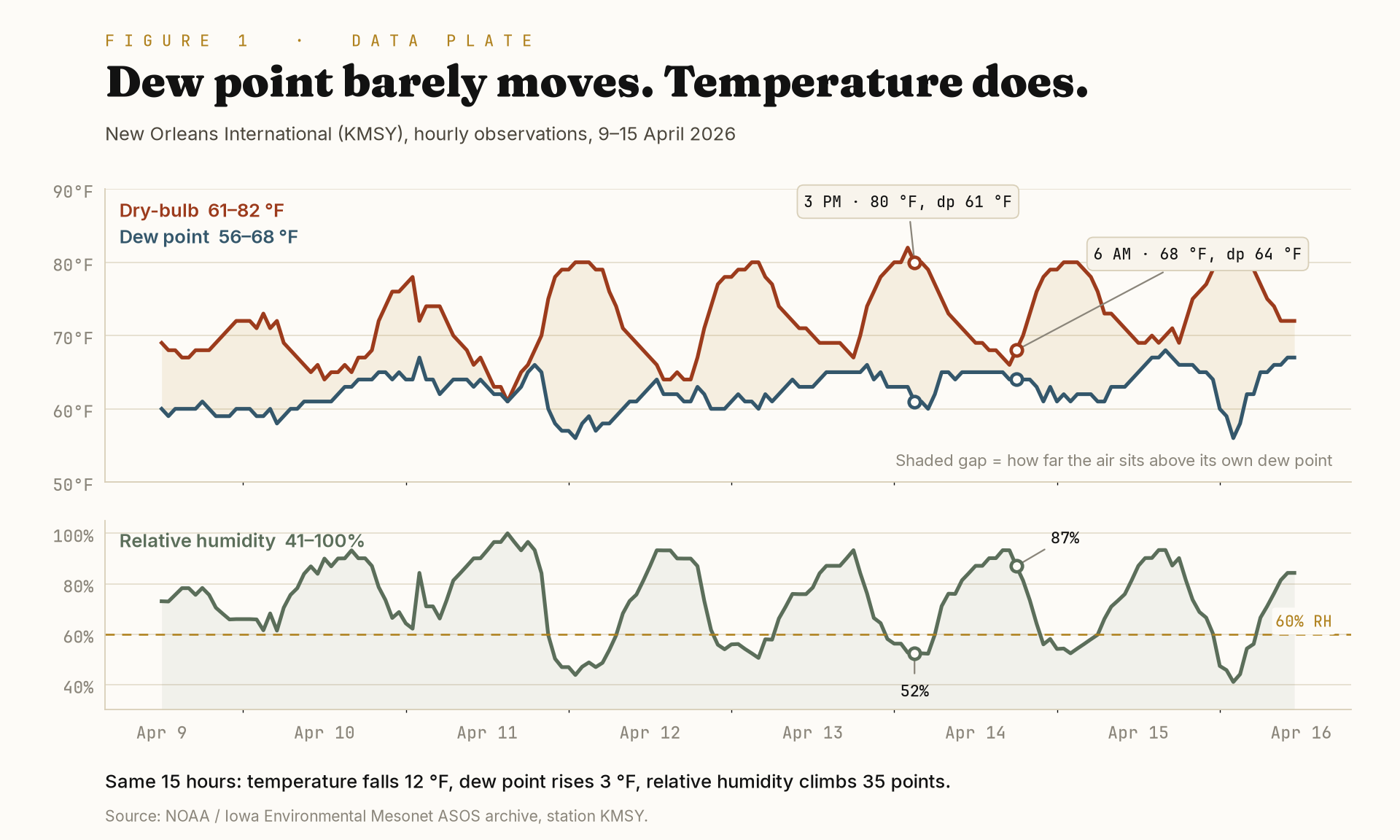
Figure 1 · One week, three lines
Source: NOAA/NWS ASOS observations via Iowa Environmental Mesonet
Seven straight days of hourly readings from the New Orleans airport, 9 through 15 April 2026.
Read the top panel first. The red line is temperature, and it saws up and down about 20 degrees every day. The blue line underneath is dew point, and it is much smoother by comparison — it stayed between 56 °F and 68 °F all week while the temperature covered 61 °F to 82 °F. The shaded area between them is the gap.
Watch the gap open every afternoon and squeeze shut every night. That is the entire argument, drawn.
Now the bottom panel, relative humidity. Notice it doesn't spike and recover — it ramps. On six of the seven days it crossed 60 % somewhere between mid-afternoon and 8 PM, kept climbing all night, and topped out in the small hours, between 1 and 6 AM, every single day in the record. One morning hit 100 %. The other six stalled at 93 %. Then the sun comes up, the temperature climbs, the gap opens back up, and by early afternoon the same air is reading in the 40s and 50s and everybody agrees it is a beautiful day.
The peak lands at the coldest hour of the night, not the wettest. That is the tell. If water were arriving, the peak would follow the water. It follows the thermometer.
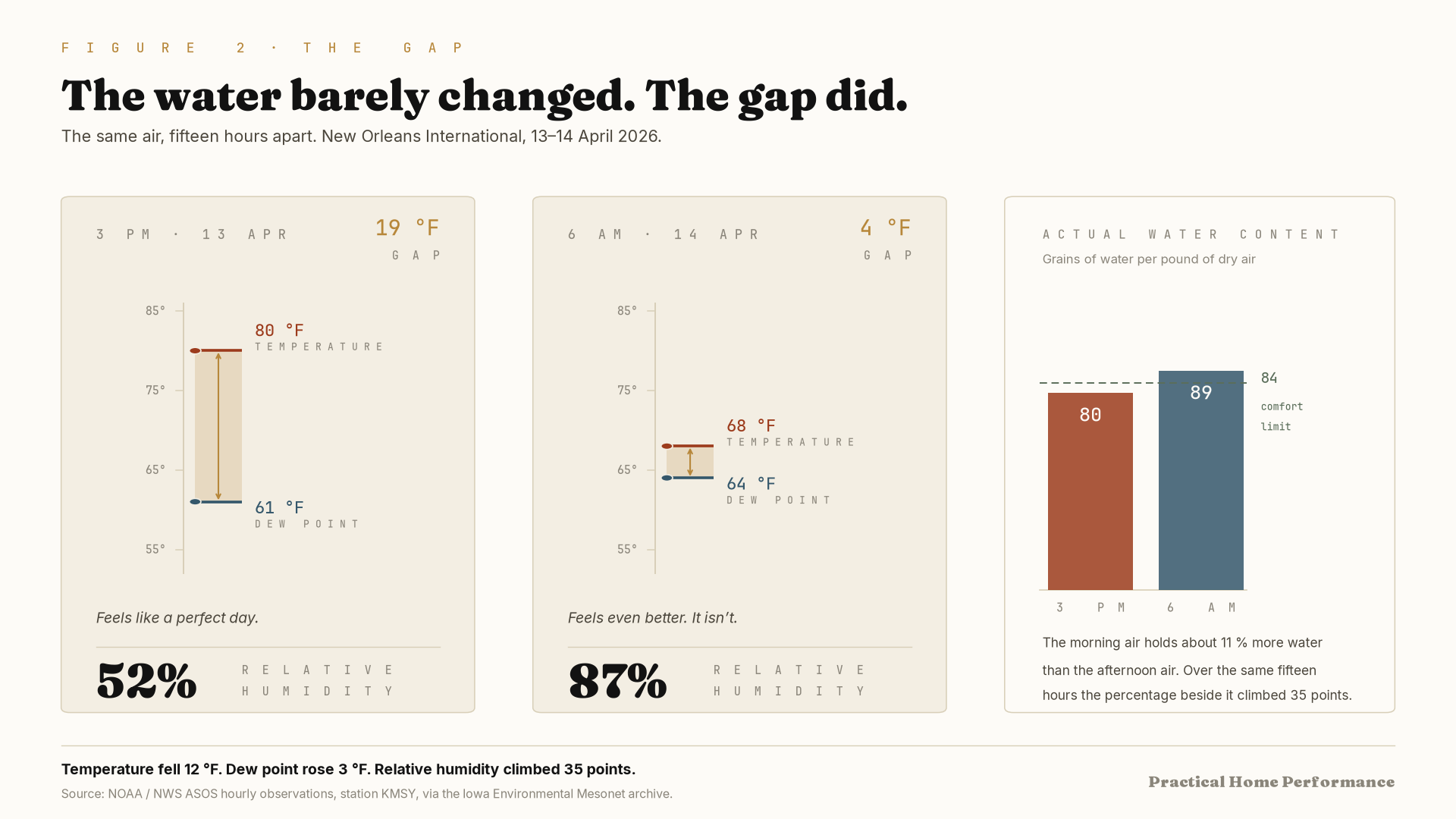
Figure 2 · The same air, fifteen hours apart
Source: NOAA/NWS ASOS observations via Iowa Environmental Mesonet
Two readings, fifteen hours apart, on the same pleasant stretch of weather.
The afternoon air and the morning air contain very nearly the same amount of water — the bars on the right are almost the same height. What changed is how far the temperature sits above the dew point. In the afternoon there is room to spare. By six the next morning the two have nearly met.
The relative humidity number went from 52 % to 87 %. The water went up by about a tenth. One of those numbers is telling you about the air. The other is mostly telling you what time it is.
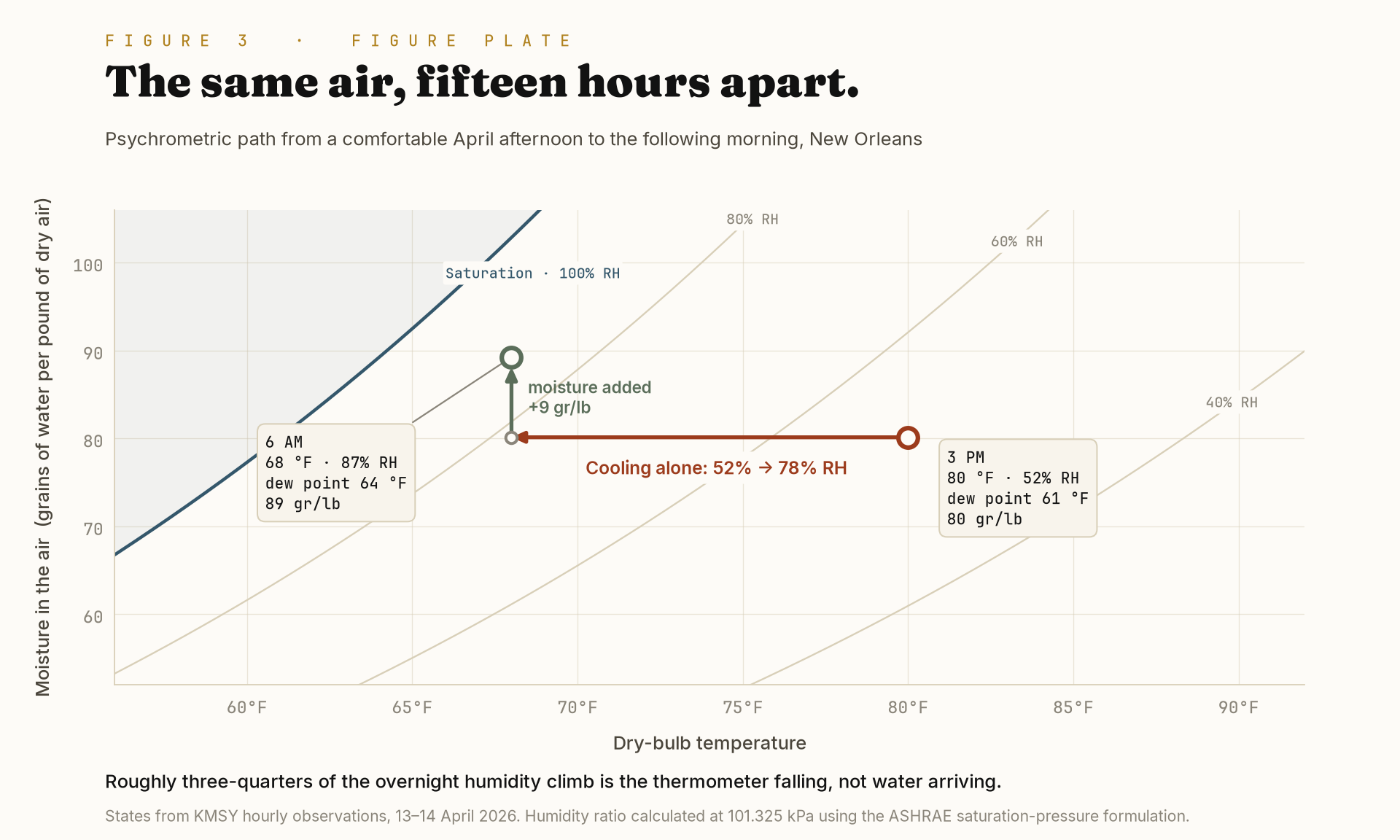
Figure 3 · The same two points, for the psychrometric crowd
Source: Psychrometric properties calculated at 101.325 kPa using the ASHRAE saturation-pressure formulation.
If you read psychrometric charts, this is the same event with the bookkeeping shown. Skip it if you don't.
Start at 80 °F with a 61 °F dew point — 80 grains per pound, 52 % RH. Move left along a horizontal line, holding moisture content fixed, until you hit 68 °F. That move is pure cooling with nothing added, and it lands at 78 % RH on its own. So 26 of the 35 points came from the thermometer alone.
The rest of the move is vertical. The dew point really did rise 3 °F overnight, from 61 °F to 64 °F, adding about nine grains per pound. That is what carries it from 78 % to the observed 87 %.
Those nine grains are worth naming, because they are a real effect rather than a rounding error. After dark the ground and the vegetation keep giving off moisture while the air above them cools and stops mixing upward. In the Gulf South in April the soil is wet, the water table is high, and there is a lot of transpiring vegetation. Near-surface moistening of that kind is the likeliest source on a night like this one. The quantitative point holds regardless of the exact split: the moisture increase is small, and the temperature drop is large.
Where the comfort standard draws its line
ASHRAE Standard 55 is the comfort standard that heating and cooling design leans on. Its comfort zone has an upper moisture limit, and our two readings land on opposite sides of it.
| 3 PM, 13 Apr | 6 AM, 14 Apr | |
|---|---|---|
| Temperature | 80 °F | 68 °F |
| Dew point | 61 °F | 64 °F |
| Relative humidity | 52 % | 87 % |
| Water content | ~80 gr/lb | ~89 gr/lb |
| Inside the comfort limit | Yes | No |
The afternoon air on a perfect Louisiana spring day is, by moisture content, inside the comfort envelope. The air fifteen hours later, in the same beautiful weather, is outside it. Nobody's preferences changed. The air barely changed. The clock changed.
That is a defensible, numeric way to say something homeowners already know by feel: the evening is different, and it isn't imagination.
Why your house cares
This is the point where building-science writing usually overshoots, so it is worth separating what is real from what gets exaggerated.
A big number that turns out not to mean much. It is easy to make an open window sound catastrophic with one calculation. Take that 89-grain morning air, move it through a 2,000-square-foot house for ten hours, and ask how much water you would have to pull back out of it — through the air conditioner, or poured down the sink from a dehumidifier — to bring all of it down to a comfortable indoor dew point. The answer lands somewhere near ten gallons. That sounds like a flood, and it is the wrong way to think about it. Nearly all of that vapor rides straight back out on the same airflow that carried it in — you never have to dry it, because it does not stay. Air is a conveyor belt, not a bucket. No house gains ten gallons overnight.
What sticks is what your surfaces soak up. Wood, paper facings, gypsum, cotton, books, upholstery, the dust in your return — all of it trades moisture with the surrounding air until it comes into balance with the relative humidity around it. The wetter the air in the room, the wetter those materials get. The Forest Products Laboratory publishes the numbers for wood, and the spread between comfortable air and 90 % air is large.
A single night is nowhere near long enough to change a 2x4 all the way through. But the outermost fraction of a millimeter of every exposed surface responds within minutes — and that surface layer is exactly where mold starts, and exactly what a humidity sensor sitting in the room is reading. Run that cycle every night for six weeks of spring and the inside surfaces of a house are living at a meaningfully damper average than the daytime readings suggest.
The same water is out there all day. The materials only grab at it after dark. This is the part that catches people, and it is worth being exact about. The afternoon air holds about 80 grains of water per pound; the morning air, about 89. Very nearly the same air. But wood, paper, gypsum and cotton do not respond to how much water is in the air — they respond to relative humidity, which is why every equilibrium-moisture table ever published is indexed to a percentage instead of a dew point. At 80 °F and 52 %, that water leaves your bookshelves alone. At 68 °F and 87 %, the very same water is pulling them toward roughly double the moisture content. Nothing was delivered. The thermometer changed the terms of the trade.
Which raises the fair objection: if the dew point rose, isn't moisture genuinely being added? Yes — and the sizes are the whole point. Those nine grains are real water entering the outdoor air, and if the windows are open, that air comes inside. But three degrees of dew point are a nudge and twelve degrees of cooling are the damage. Closing the windows stops the nudge and does nothing about the cooling: the house still drops toward its own dew point overnight, so indoor relative humidity still climbs on moisture that was already in there. That is why the shoulder-season fix is almost never shut it up tighter. It is drier air, or removal.
And your air conditioner is off at exactly the wrong time. This is the part that turns into a service call. During spring and fall, when outdoor and indoor temperatures are close, cooling systems barely run — and a system that isn't running isn't removing moisture. Building Science Corporation's work on hot-humid ventilation puts it plainly: in these part-load periods HVAC systems “do not regularly operate,” and “there is also almost no provision for moisture removal during this time by the HVAC system.” Because indoor and outdoor temperatures nearly match, the load in these periods “is almost completely latent” — essentially all moisture and no heat.6
Put it together and you get the pattern I actually see in the field: indoor humidity complaints in the Gulf South cluster in April, May, October, and November — not in the worst of August. In August the air conditioner runs for hours at a stretch and wrings out moisture as a side effect of doing its real job. In April it hardly runs at all, and the moisture walks in through the windows you opened because the afternoon was so nice.
What to do about it
Set your window rule on outdoor dew point, not outdoor temperature. These are the working thresholds I use. They are my professional judgment, not a code requirement:
- Dew point below 55 °F — outdoor air will dry your house out. Open everything.
- 55 to 60 °F — roughly a wash. Fine for fresh air, not a drying strategy.
- 60 to 65 °F — you are bringing moisture in. Acceptable for a while if you know that's the trade.
- Above 65 °F — you are wetting the house down. Close up and let the equipment work.
Notice where our example morning lands. At 6 AM the outdoor dew point was 64 °F. The temperature was a pleasant 68 °F. Every instinct says open the window. The dew point says don't.
Indoor and outdoor relative humidity are not comparable numbers. Your indoor sensor reads 78 °F and 52 %; your outdoor sensor reads 68 °F and 87 %. Thirty-five points apart, which makes the outside air sound drastically wetter. It is wetter, but only by about a fifth. The two readings were taken at two different temperatures, so they are being scored against two different yardsticks, and the gap between them is not the number you think it is.
Convert both to dew point and it reads at a glance: 59 °F inside, 64 °F outside. The outdoor air is the wetter of the two, so opening the window moves the house the wrong way. Two numbers on one scale, directly comparable — which is the entire reason to log dew point instead of percentages.
This is the same discipline that shows up in Nº 005, How moisture reduces R-value, coming from the other side. That article is about what happens once moisture is inside an assembly. This one is about the daily cycle that keeps delivering it to the door.
What this article does not say
- It is not an argument against ventilation. Houses need outdoor air for indoor air quality, and the ASHRAE 62.2 ventilation rates exist for good reasons. The argument here is about when — and about pairing ventilation with dehumidification during the shoulder seasons.6
- It is not an argument that night ventilation is always wrong. Genuinely dry air does reach the Gulf Coast. Three days before this window, on 6 and 7 April 2026, dew points at the same station spent most of two days between the 20s and the low 50s.3 With air like that outside, open everything. But notice what the plotted week does not contain: one single dry night. The two driest afternoons in Figure 1, on 11 and 15 April, both got their dew points down to 56 °F — and both gave it all back after dark, recovering to 64 °F and 67 °F by the small hours. A dry afternoon is not a promise about the night that follows it, and you cannot tell which kind of night you are having by stepping outside and noticing it feels cooler.
- It does not quantify anything about your house. Every number here describes outdoor air at one weather station. What your particular walls, surfaces, and equipment do with that air is a measurement problem.
- It is not a claim that your walls are condensing on a spring night. Liquid water needs a surface colder than the arriving air's dew point, and inside a conditioned house there usually isn't one — which is why you do not walk in and find things sweating. The genuinely cold surfaces in this climate are somewhere else: duct sheet metal and boot collars in a vented attic or crawlspace, a slab edge and the soil beneath it, the sheet metal and glass on a car that sat outside all night. Those are the places 64-degree air finds something cold enough to give up liquid water. What happens indoors is milder and slower — surfaces taking up vapor and room humidity running high, not water forming inside a wall.
What you are actually up against
Strip out the psychrometrics and the comfort problem in this climate reduces to one sentence: for about two months in spring and two more in fall, how your house feels is governed by moisture, and almost nothing in the house is working on moisture.
That is why the eight-o'clock complaint is so hard to argue with and so hard to fix. The thermostat is satisfied, and it is right — the house really is cooler. The equipment agrees with the thermostat and stays off. Meanwhile the surfaces are quietly loading up, the room is reading 70 % and climbing, and the only control anybody has is a temperature setpoint that has nothing to do with the actual problem. So people push the thermostat down, buy a few hours of relief, and pay for it on the next bill. They are pulling the one lever they have, on the wrong variable.
And the reason this lands harder here than across most of the country comes down to two numbers that rarely get discussed together.
Our dew points do not leave on their own. Across much of the Mountain West a summer night arrives with a dew point in the 40s or lower. Open the windows and the house genuinely dries out; night ventilation is a real cooling and drying strategy there, and it is written into the local building culture. Dry air does reach the Gulf Coast — those 6 and 7 April readings are proof — but it arrives behind a front, on the front's schedule, not at nightfall. Then look again at what Figure 1 does not contain: one single dry night. Seven days in the mildest stretch of our year, and the dew point bottomed out at 56 °F twice, briefly, before climbing back into the mid-60s by the small hours. You cannot count on the night to bring you anything.
And our thermometer does not travel far. This is the half that surprises people, and it is the opposite of what you would guess. A dry climate gets a 40- or 50-degree daily swing, which is exactly what makes night ventilation pay there. We get about twelve. Ninety-five at three in the afternoon, mid-eighties before dawn. That small swing sounds merciful, and in heating terms it is — but it also means our air spends nearly the entire day and night sitting close to its own dew point. The gap never opens up. High relative humidity is not an event here. It is the resting state, and it is the resting state on the same water all day long.
Put those together and you have the local situation stated honestly: air carrying eighty-some grains around the clock for months at a stretch, no dry night available to flush the house with, wet ground underneath the whole time, and cooling equipment that removes moisture only when it happens to be busy removing heat. Cold climates fight condensation on the inside of the enclosure for a few weeks in winter and get a dry summer to recover in. We fight vapor uptake on every absorbent surface in the house, across two shoulder seasons, and the equipment is off for both of them.
None of which calls for a bigger air conditioner. It calls for knowing which number you are reading. Judge outdoor air by its dew point before you open a window, log dew point instead of percentages, and expect your moisture months to be the pleasant ones rather than the hot ones. That is most of the fight.
Sources & further reading
Steven Babin, “Water Vapor Myths: A Brief Tutorial,” University of Maryland Department of Atmospheric and Oceanic Science. https://www2.atmos.umd.edu/~stevenb/vapor/↩︎
“Net Condensation: Myth and Reality,” METEO 3, Penn State University Department of Meteorology and Atmospheric Science. https://courses.ems.psu.edu/meteo3/node/2223↩︎
Hourly ASOS observations, station KMSY (New Orleans International Airport), 9–15 April 2026, retrieved from the Iowa Environmental Mesonet ASOS/AWOS archive of NOAA National Weather Service data. Humidity ratios calculated at 101.325 kPa using the ASHRAE saturation-pressure formulation. https://mesonet.agron.iastate.edu/request/download.phtml↩︎↩︎
ANSI/ASHRAE Standard 55, Thermal Environmental Conditions for Human Occupancy. The graphic comfort zone method is limited to a humidity ratio at or below 0.012 kg water per kg dry air. See Addendum d to ANSI/ASHRAE Standard 55-2017. https://www.ashrae.org/file%20library/technical%20resources/standards%20and%20guidelines/standards%20addenda/55_2017_d_20200731.pdf↩︎
Samuel V. Glass and Samuel L. Zelinka, “Moisture Relations and Physical Properties of Wood,” Chapter 4 in Wood Handbook — Wood as an Engineering Material, General Technical Report FPL-GTR-282, USDA Forest Service Forest Products Laboratory, 2021. Table 4-2. https://www.fpl.fs.usda.gov/documnts/fplgtr/fplgtr282/chapter_04_fpl_gtr282.pdf↩︎
Building Science Corporation, “BSD-107: Understanding Ventilation in Hot-Humid Climates,” 2006. https://buildingscience.com/documents/digests/bsd-107-understanding-ventilation-in-hot-humid-climates↩︎↩︎