
In this field note
- Why this matters — briefly
- What the number on the bag actually is
- What a guarded hot plate does
- The four conditions the test holds still
- Two questions the test was never asked
- Four phrases worth keeping straight
- Why this bites harder on the Gulf Coast
- What to do with the number now
- Frequently asked questions
- Keep reading
- Sources & footnotes
Why this matters — briefly
For the non-reflective insulation discussed here, federal rule requires the labeled R-value to be measured on the material alone, with no airspace counted, at a 75°F mean temperature and a temperature difference of 50°F ± 10°F across the specimen.1 “Mean” is the average of the warm-side and cold-side temperatures, not the room temperature. Nothing about that is dishonest. It is a real measurement under defined conditions, which makes comparisons between products possible.
But a flat, uniform sample without framing or free moisture, sitting between two temperature-controlled plates, is not a ceiling.46 Your ceiling has joists, wiring, top plates, can lights, and a hatch. Air may move through gaps and around the insulation. A gap between the label and the ceiling does not, by itself, establish a manufacturing defect or fraud. It can reflect the difference between a material property and the performance of an assembly.
The bag itself says so too. Federal rule requires the label to carry this sentence: "To get the marked R-value, it is essential that this insulation be installed properly."2
What the number on the bag actually is
R-value measures resistance to heat flow, in units of h·ft²·°F/Btu. Higher means more resistance under the same conditions.
What is less well known is that the label claim is regulated, and that the law names the ways it may be produced. The Federal Trade Commission's R-Value Rule permits four test methods for all insulation except reflective insulation: ASTM C177, the guarded hot plate; ASTM C518, the heat flow meter; ASTM C1363, the hot box; and ASTM C1114, the thin-heater apparatus.1 The headline points to a foundational laboratory method, not a claim that every bag was tested on the same apparatus.
Those four methods do not all work the same way. The heat flow meter is a comparative instrument: it must be calibrated using specimens whose properties were established by the guarded-hot-plate method, C177, or the thin-heater method, C1114. ASTM C177 states that, in cases of dispute, the guarded-hot-plate method "is the recommended procedure."3 The referee is still a laboratory apparatus, not a house.
That is the distinction worth keeping. A reliable laboratory reference makes product comparisons possible. It does not make the test conditions a replica of the conditions inside your ceiling or wall.
What a guarded hot plate does
In the double-sided configuration, two specimens of the material are prepared as close to identical in thickness, area, and density as possible. One goes on each side of a heated plate. The outer face of each specimen sits against a cold plate held at a constant temperature. Measure the electrical power going into the heater, measure the temperatures, and you can calculate how much heat crossed a known area of a known thickness. The standard also permits a single-sided configuration.4
“Guarded” describes heat-path control, not protection against manufacturer influence. A separate guard heater surrounds the metered heater and is held at the same temperature to limit sideways heat flow. That helps isolate the heat passing through the specimen from heat exchanged with the surroundings.4
The specimen is also conditioned to a stable moisture content, not simply oven-dried. Unless the material's specification says otherwise, ASTM C177 calls for conditioning "at 22 ± 5°C and 50 ± 10 % relative humidity for a period of time until less than a 1 % mass change in 24 h is observed." Any alternative conditioning environment "shall be reported with the test results."7 That places the sample near ordinary indoor equilibrium rather than making it moisture-free. The standard also acknowledges that moisture within the material can cause behavior that changes during the test.7 The distinction is a stable, reported moisture condition in the lab versus moisture that can accumulate and change in service.
Orientation matters, too. Building Science Corporation's Thermal Metrics report describes common horizontal testing with downward heat flow, an arrangement that minimizes buoyancy-driven convection.13 That is not a universal requirement of the guarded-hot-plate method: ASTM C177 permits vertical or horizontal heat flow and explicitly warns that orientation can change results if convection occurs within the specimen.4 The current FTC rule specifies the 50°F ± 10°F temperature difference, but does not prescribe a specimen orientation.1
The important distinction is between heat transfer within a specimen and air leaking through a building. Plate tests do not reproduce wind washing or pressure-driven leakage through your ceiling. That does not mean all convection is impossible inside the material. Even the hot-box method, which can test larger assemblies, excludes intentional air or moisture transfer through the specimen.8
The instrument is also explicit about its limits. ASTM C177 states that “No guarding system can be constructed to force the metered heat to pass only through the test area of insulation specimen being measured.”4 Repeatability and a reported measurement uncertainty make the result useful. They do not turn it into a simulation of a house.
The four conditions the test holds still
A useful comparison needs defined conditions. These four controls and scope limits recur in the material tests, although their details vary by method. Each is a place where the house can differ.
| What the test holds still | What your house does instead |
|---|---|
| Flat and uniform. A flat, homogeneous specimen between parallel plates.4 | Joists and studs, wiring, plumbing, blocking, top plates, can lights, an attic hatch, and the corners where planes meet |
| Defined temperatures. A 75°F mean with 50°F ± 10°F across the specimen for the label test.1 | The temperatures at the two faces of attic insulation change. R-value responds differently by material, and the relationship can be nonlinear.5 |
| A defined moisture condition. C177 provides conditioning near 72°F and 50% relative humidity until mass changes by less than 1% in 24 hours, unless the material specification directs otherwise. C518 specifies no free moisture.67 | Humid air, wetting events, and moisture that accumulates faster than the assembly dries |
| No air passing through, and no airspace counted. No intentional transfer of air or moisture through the specimen, and the R-value is measured "on the insulation material alone (excluding any airspace)."18 | Pressure differences, bypass leakage at chases and top plates, wind washing at the eaves, and air-permeable insulation with no continuous air-control layer behind it |
The standards themselves describe these limits. ASTM C518 states that specimens are measured without free moisture "although in service such conditions may not be realized."6 ASTM C1363 states that it "does not permit intentional mass transfer of air or moisture through the specimen during measurements," and explains why: "Air infiltration or moisture migration can alter the net heat transfer," and the interactions are too complicated and too little studied to standardize.8
And then the warning that ought to accompany every insulation quote: ASTM C1363 cautions that its test conditions are unlikely to duplicate in-use conditions and that significant differences are possible.8
The lab is not naive. The lab told you.
Two questions the test was never asked
Framing
Here is a thing people get backwards: the guarded hot plate does not "average over" your studs and joists. It refuses to measure them at all.
ASTM C177 states that testing specimens with inhomogeneities in the direction of heat flow, “such as an insulation system with thermal bridges,” can yield location-specific results and “shall not be attempted with this type of apparatus.”4 A thermal bridge is a more conductive path through the assembly, such as a stud crossing the insulation layer. C518 puts it harder: with a thermal bridge running parallel to the heat flow, “the results obtained may well have no meaning.”6 C177 directs that assembly question to the hot box instead.4 For representative construction testing, C1363 requires the specimen to “duplicate the framing geometry, material composition and installation practice, and orientation of construction.”8
That is a scope boundary, not an error. Nobody mismeasured anything. The material test was never asked the assembly question.
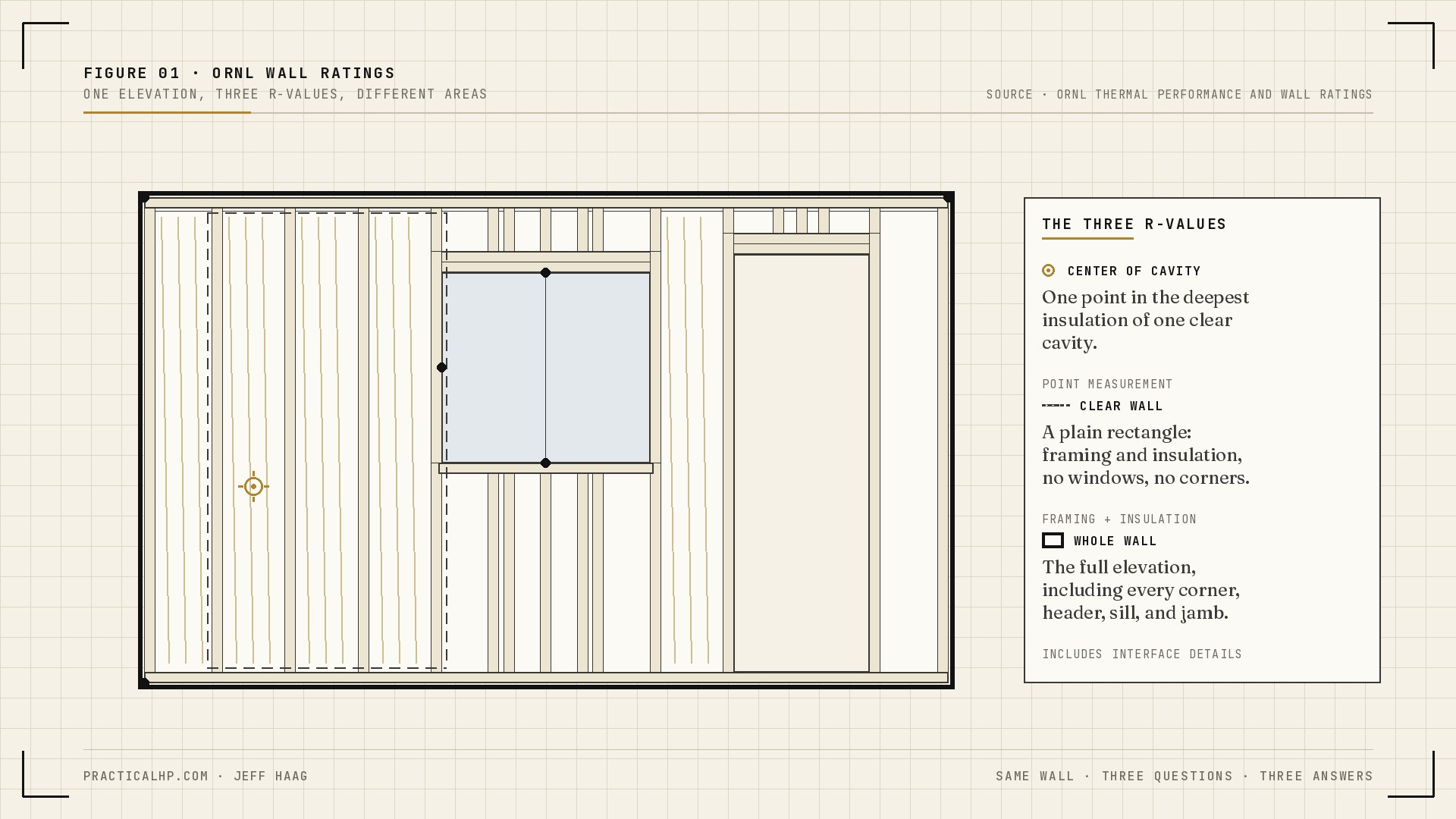
When somebody does ask it, the answer moves. Oak Ridge National Laboratory built a vocabulary for this: center-of-cavity R-value at the point with the most insulation, clear-wall R-value for a plain section with insulation and framing but no windows or corners, and whole-wall R-value including the interface details — corners, wall-to-roof, wall-to-floor, window headers, sills, jambs. ORNL reports that framing factors in real construction run from 15% to 40% of opaque wall area and are "frequently underestimated," that interface details can affect "as much as 50% of the overall wall area," and that for some conventional wall systems the whole-wall R-value comes in "as much as 40% less" than the clear-wall figure.9
Across the eighteen wall systems in ORNL's table, the whole-wall-to-clear-wall ratio ranged from about 73.5% to 103.3%. One system scored above 100%.9 There is no universal derating percentage here. A percentage is useful only when it is tied to a particular assembly and method.
Installation
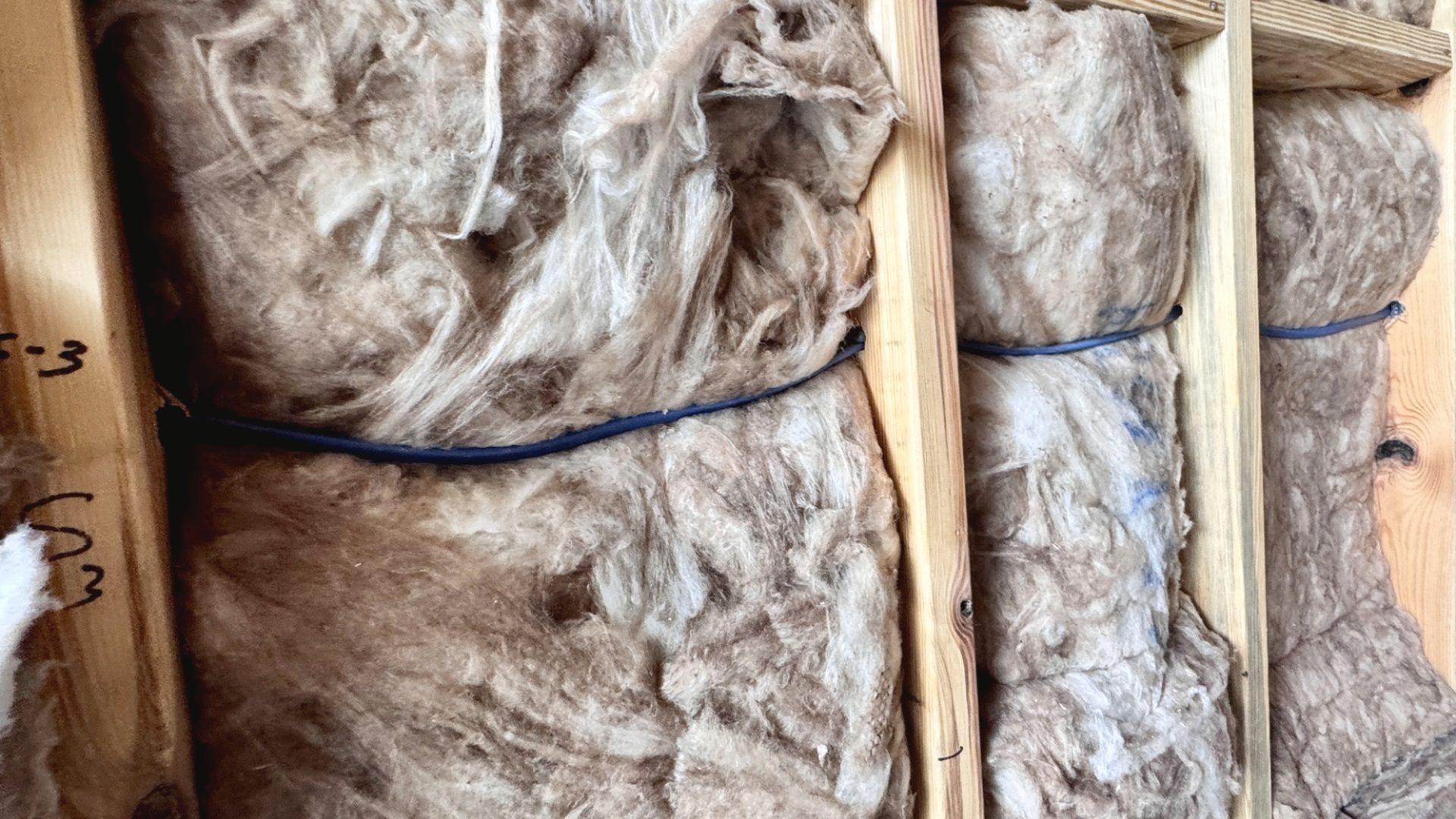
The label assumes the insulation was installed correctly. There is a written definition of correctly, and it is stricter than most people expect.
For home energy ratings, “correctly” has written criteria. ANSI/RESNET/ICC 301 requires the density and thickness needed for the specified R-value, along with fit around obstructions such as framing, wiring, and pipes.10 The companion article on insulation grading explains the tolerances and what to look for on a walkthrough. A rating standard is not, by itself, a ruling on a particular home's code compliance.
Verification is part of that assessment. Insulation confirmed present but not fully inspected is generally modeled as Grade III and recorded as “not inspected.” The standard includes exceptions, including qualifying factory inspections and thermographic assessment under specified credentials.11 Unverified work does not automatically receive the best grade.
That is the whole argument in miniature. The number on the bag never changed. What the ceiling or wall delivers with it did.
Four phrases worth keeping straight
Most confusion in this subject comes from using one term for four different things. These four are used consistently through the rest of this series, and they climb in one direction: from the material, to the material in your house, to the material working under real conditions, to the building.
Material R-value is the label. One specimen, defined conditions, measured in a laboratory. It answers: how does this material compare to that material?
Installed R-value is that same material as it actually sits in your house — at the thickness and density it actually reached, compressed or not. It answers: did we get what we bought?
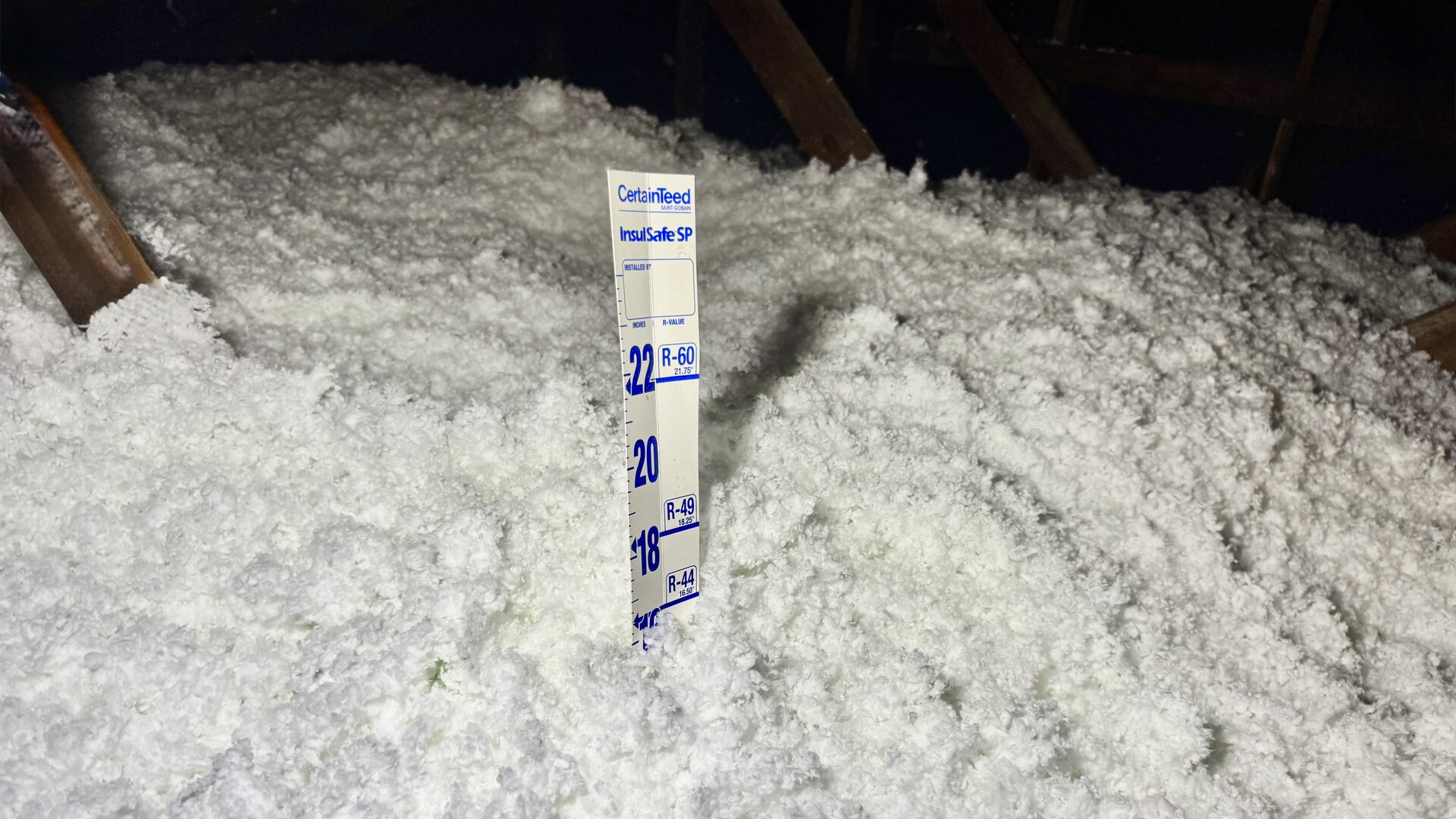
Effective R-value is that installed material adjusted for the conditions it is actually working in: the temperature it is running at, the moisture it is holding, and how completely it covers the surface it is supposed to cover. It answers: what is this insulation delivering right now, in August, as installed? A later article in this series builds that arithmetic explicitly.
One discipline goes with that third term. This series keeps enclosure air leakage separate from the insulation's effective R-value. A blower-door reading alone does not define an R-value penalty; estimating its heat-and-moisture load requires additional assumptions. Air leakage is reported as a separate load, not folded into a blanket multiplier.
Whole-assembly thermal performance is the broader picture of what the ceiling, wall, or floor delivers as built, including framing, interfaces, and air control. It answers: what does this part of my house actually do? ORNL's whole-wall R-value captures heat transmission through the opaque wall and its interface details.9 That is an assembly R-value, but it is not an all-in measure of the air leakage, moisture transport, and operating conditions of the building.
The label helps you compare materials. Comfort and energy bills depend on the installation, the rest of the enclosure, and the HVAC system as well. A product number cannot settle those questions by itself.
Why this bites harder on the Gulf Coast
Three conditions that matter where we live.
First, temperature. The label condition is a 75°F mean, not a 75°F attic-air temperature. The relevant comparison is the average temperature across the insulation's two faces. Building Science Corporation's polyisocyanurate research illustrates why this matters: its temperature response can be nonlinear, so a result at one mean temperature does not predict every service condition.5 That finding is not a universal loss factor for fiberglass or cellulose. The direction and size of the change depend on the material and conditions.
Second, our cooling season is long, and it is humid. A stable, room-conditioned test specimen is not an assembly exposed to changing moisture conditions. The hot-box standard explicitly cautions that laboratory conditions are unlikely to duplicate conditions in use.8
Third, the HVAC system can drive air across the enclosure. Where ducts or air handlers sit outside the conditioned space, in an attic or crawlspace, leakage and supply/return imbalances can create pressure differences that increase uncontrolled air exchange. Supply leakage to those spaces can depressurize the house and draw replacement air through gaps in the enclosure.14 During hot, humid weather, that incoming air adds heat and moisture the cooling system must remove. This compounds the performance problem, but it is an air-leakage load, not a blanket reduction in the insulation's R-value. The airflow article in this series takes that mechanism further.
One concrete installation detail is worth checking. The RESNET grading requirements call for a securely fastened wind block, air chute, or eave baffle at the eave or soffit vent of every cavity containing air-permeable insulation in a ventilated attic. It must extend above the insulation surface or to the ridge vent.10 This means every vented cavity, not a requirement to add vents to every bay. The vent path and the ceiling air-control layer both need attention; a baffle does not seal ceiling leaks. The R-value on the bag verifies neither detail.
What to do with the number now
Not a product recommendation. A short list of better questions.
- Buy on the label, verify on the install. The label is the right tool for choosing a product. It is not evidence of what got installed.
- Ask about thickness and coverage, not just R. For loose-fill, federal rule requires the installer's receipt to show coverage area, initial installed thickness, minimum settled thickness, R-value, and the number of bags used.12 Ask for it.
- Treat bag count as an inventory record. It tells you what came off the truck, not what the ceiling achieves. Same for one depth measurement at one convenient spot.
- Ask what the air-control layer is, and where it is continuous. Insulation is thermal control. It is a separate job from air control, and asking the question tends to reveal quickly whether anyone has thought about it.
- In a vented attic, check every eave or soffit vent path. Look for the required wind block or baffle and a clear ventilation path, rather than assuming perforated soffit material proves the path is open.10
- Do not rank finished jobs by the label alone. A higher labeled R-value does not guarantee better assembly performance. Any claimed percentage difference needs an assembly-specific calculation or measurement.
Frequently asked questions
Is the R-value on the bag a lie? The existence of a lab-to-house difference does not make the label a lie. For the non-reflective insulation discussed here, federal rule requires the claim to be based on one of four named methods.1 The label is not a guarantee of the whole house's performance.
Does the label ignore settling and aging? No. Federal rule requires polyurethane, polyisocyanurate, and extruded polystyrene to be tested on samples that “fully reflect the effect of aging,” loose-fill cellulose to be tested at settled density, and loose-fill mineral wool and spray-applied cellulose to be tested on samples that “fully reflect the effect of settling.”1 Aging and settling are in the rule. The label still does not verify your particular installation or every in-service condition.
So what percentage of my R-value am I actually losing? There is no defensible universal answer. It depends on the assembly, the coverage, the framing, the air control, and the conditions — which is why the rest of this series takes those one at a time.
Keep reading
When Air Moves Through Insulation separates enclosure leakage, wind washing, and convection within an assembly. The insulation-grading field note takes up installation quality, including how grades are assigned and what to look for on a walkthrough.
Also available: How moisture reduces R-value, on the interaction between moisture and thermal performance, and Dew Point Doesn't Sleep, on temperature, humidity, and condensation.
Sources & footnotes
- Federal Trade Commission. 16 CFR § 460.5 — R-value tests. Four permitted test methods (ASTM C177-13, C518-17, C1363-11, C1114-06); mean temperature of 75°F with a temperature difference of 50°F ± 10°F; tests conducted "on the insulation material alone (excluding any airspace)"; aging and settled-density requirements. https://www.law.cornell.edu/cfr/text/16/460.5
- Federal Trade Commission. 16 CFR § 460.12 — Labels. Required disclosure: "To get the marked R-value, it is essential that this insulation be installed properly." https://www.law.cornell.edu/cfr/text/16/460.12
- ASTM International. C518: Standard Test Method for Steady-State Thermal Transmission Properties by Means of the Heat Flow Meter Apparatus — calibration against specimens previously measured by C177 or C1114. https://www.astm.org/standards/c518 — and ASTM C177-19, scope, on the guarded hot plate as the recommended procedure in cases of dispute. https://www.astm.org/c0177-19.html
- ASTM International. C177-19: Standard Test Method for Steady-State Heat Flux Measurements and Thermal Transmission Properties by Means of the Guarded-Hot-Plate Apparatus. Two-specimen configuration; flat, homogeneous specimen requirement; guarding limitation; exclusion of specimens with thermal bridges. https://www.astm.org/c0177-19.html
- Building Science Corporation. Information Sheet 502: Temperature Dependence of R-values in Polyisocyanurate Roof Insulation. Non-linearity of the temperature relationship; label testing does not account for real-life temperature conditions and installations. https://buildingscience.com/documents/information-sheets/info-502-temperature-dependent-r-value
- ASTM International. C518, §4.3.1 — thermal properties obtained on specimens containing no free moisture, "although in service such conditions may not be realized"; thermal-bridge warning. https://www.astm.org/standards/c518
- ASTM International. C177-13, §7.3 (Specimen Conditioning) and Note 17. Specimens conditioned "at 22 ± 5°C and 50 ± 10 % relative humidity for a period of time until less than a 1 % mass change in 24 h is observed"; alternative conditioning environments permitted but "shall be reported with the test results"; "It is possible that moisture content within the material will cause transient behavior." https://cdn.standards.iteh.ai/samples/85933/a4dc3d2119494839a0d64b77b076e14a/ASTM-C177-13.pdf
- ASTM International. C1363-19: Standard Test Method for Thermal Performance of Building Materials and Envelope Assemblies by Means of a Hot Box Apparatus. Requirement to duplicate framing geometry, material composition, and installation practice; prohibition on intentional mass transfer of air or moisture; caution that test conditions are unlikely to duplicate in-use conditions. https://store.astm.org/c1363-19.html
- Oak Ridge National Laboratory. Thermal Performance and Wall Ratings. Center-of-cavity, clear-wall, and whole-wall definitions; framing factors of 15–40%; interface details affecting up to 50% of wall area; whole-wall versus clear-wall comparison table. https://web.ornl.gov/sci/buildings/docs/Thermal-Performance-and-Wall-Ratings.pdf
- ANSI/RESNET/ICC 301-2022, Normative Appendix A — Inspection Procedures for Insulation Grading and Assessment. General installation requirements, density and thickness, fit around obstructions, and vented-attic wind block / air chute / eave baffle requirement. https://www.resnet.us/wp-content/uploads/ANSIRESNETICC301-2022_resnetpblshd.pdf
- ANSI/RESNET/ICC 301-2022, §4.2.2.3.1. Grade III / “not inspected” treatment for insulation confirmed present but not fully inspected; exceptions for specified factory and pre-manufactured assemblies; credentialed thermographic inspection provisions. https://www.resnet.us/wp-content/uploads/ANSIRESNETICC301-2022_resnetpblshd.pdf
- Federal Trade Commission. 16 CFR § 460.17 — Installer receipts. Required disclosure of coverage area, initial installed thickness, minimum settled thickness, R-value, and number of bags used for loose-fill. https://www.law.cornell.edu/cfr/text/16/460.17
- Straube, John. Building Science Corporation, RR-0901: Thermal Metrics for High Performance Enclosure Walls: The Limitations of R-Value (cover dated 2007; PDF copyright 2009). Discussion of horizontal specimen orientation, downward heat flow, and suppression of buoyancy-driven convection. This historical account describes common arrangements, not a universal restriction in C177. Current label-test temperatures are taken from §460.5 in footnote 1. https://buildingscience.com/sites/default/files/migrate/pdf/RR-0901_Thermal_Metrics.pdf
- Pacific Northwest National Laboratory, Building America Solution Center. Building Science Introduction — Air Flow. HVAC duct leakage, supply/return imbalances, enclosure pressure differences, and mechanically driven infiltration. https://basc.pnnl.gov/information/building-science-introduction-air-flow