The equipment quote came before the enclosure diagnosis
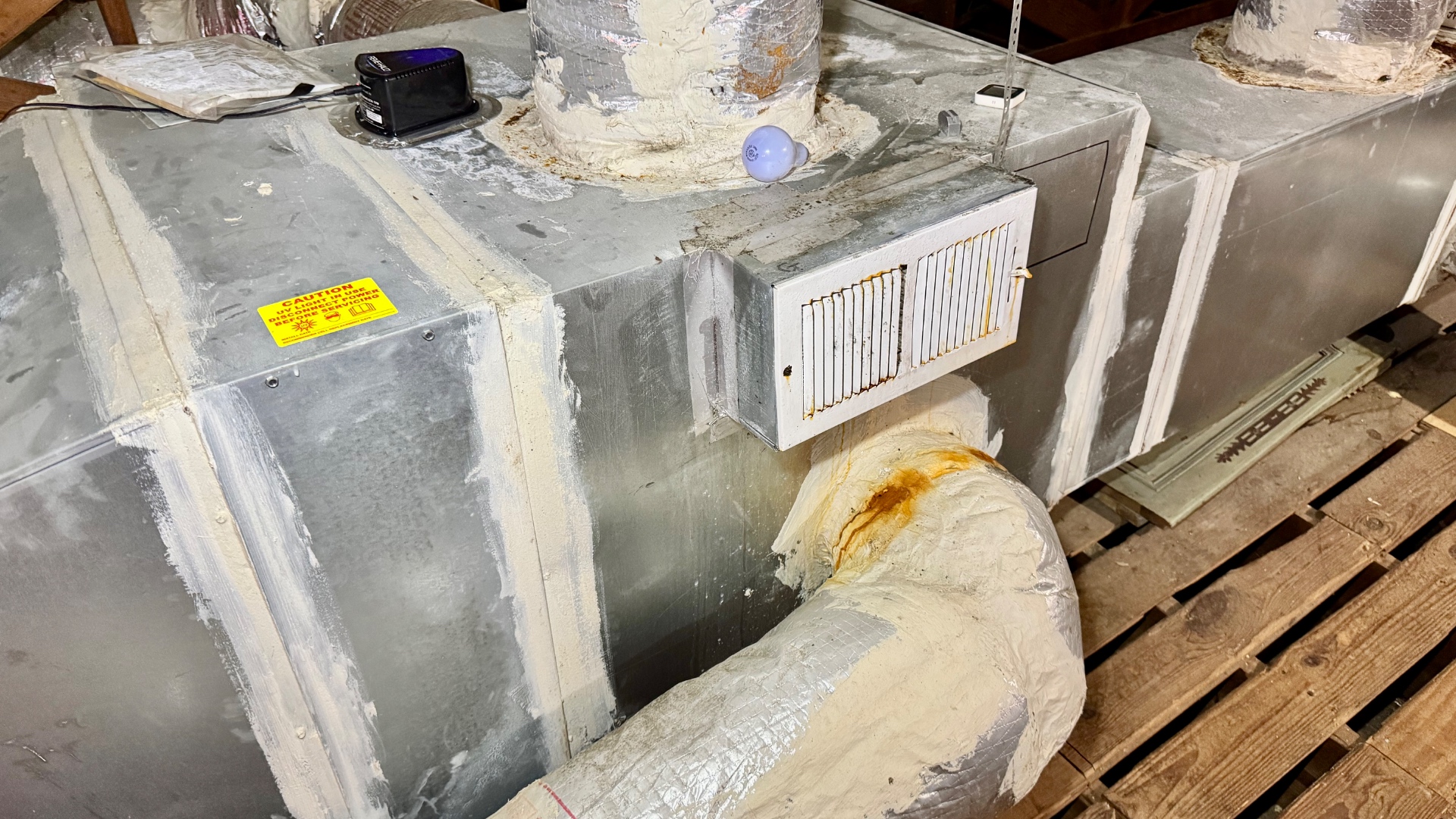
The homeowner called because the second floor struggled to maintain the desired temperature and the attic was full of sweating ductwork. Water was collecting on metal ducts and boots, reaching the ceiling below, appearing at a switch plate, and running down walls. Interior wall cavities connected with exterior wall cavities and the attic, creating additional pathways through which humid air could move.
An air-conditioning contractor had already tried to help. The attic had been sold to a previous homeowner as a “conditioned attic,” and the contractor most likely assumed the roofline enclosure was complete. A supply branch had been added to introduce conditioned air. An opening had also been cut in the return plenum, apparently for a filtered return-air grille, but it had been left open.
When the sweating continued, the proposed next step was a dedicated attic dehumidifier costing more than $20,000, with an additional maintenance commitment. That was the proposal on the table when I was called in.
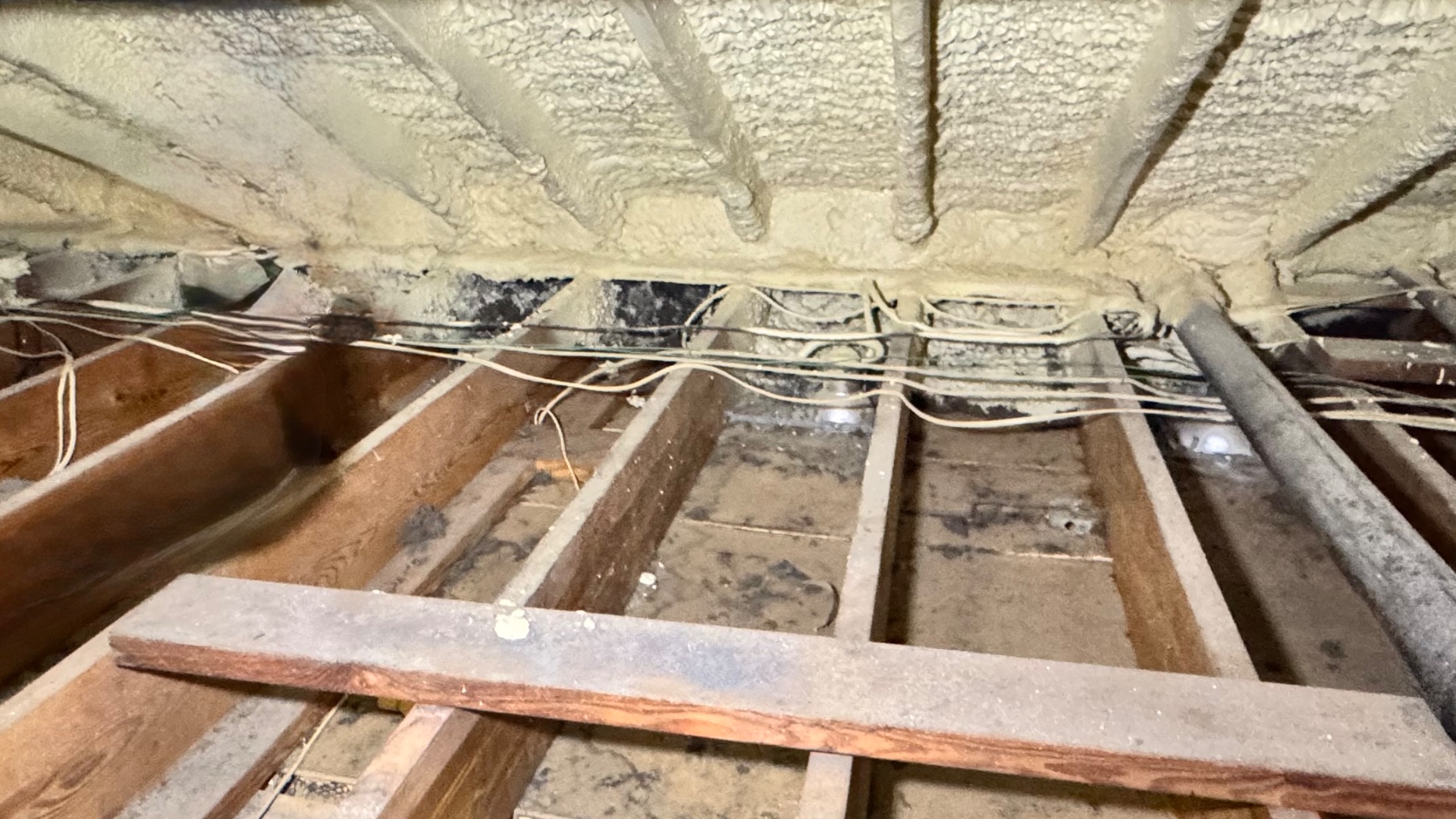
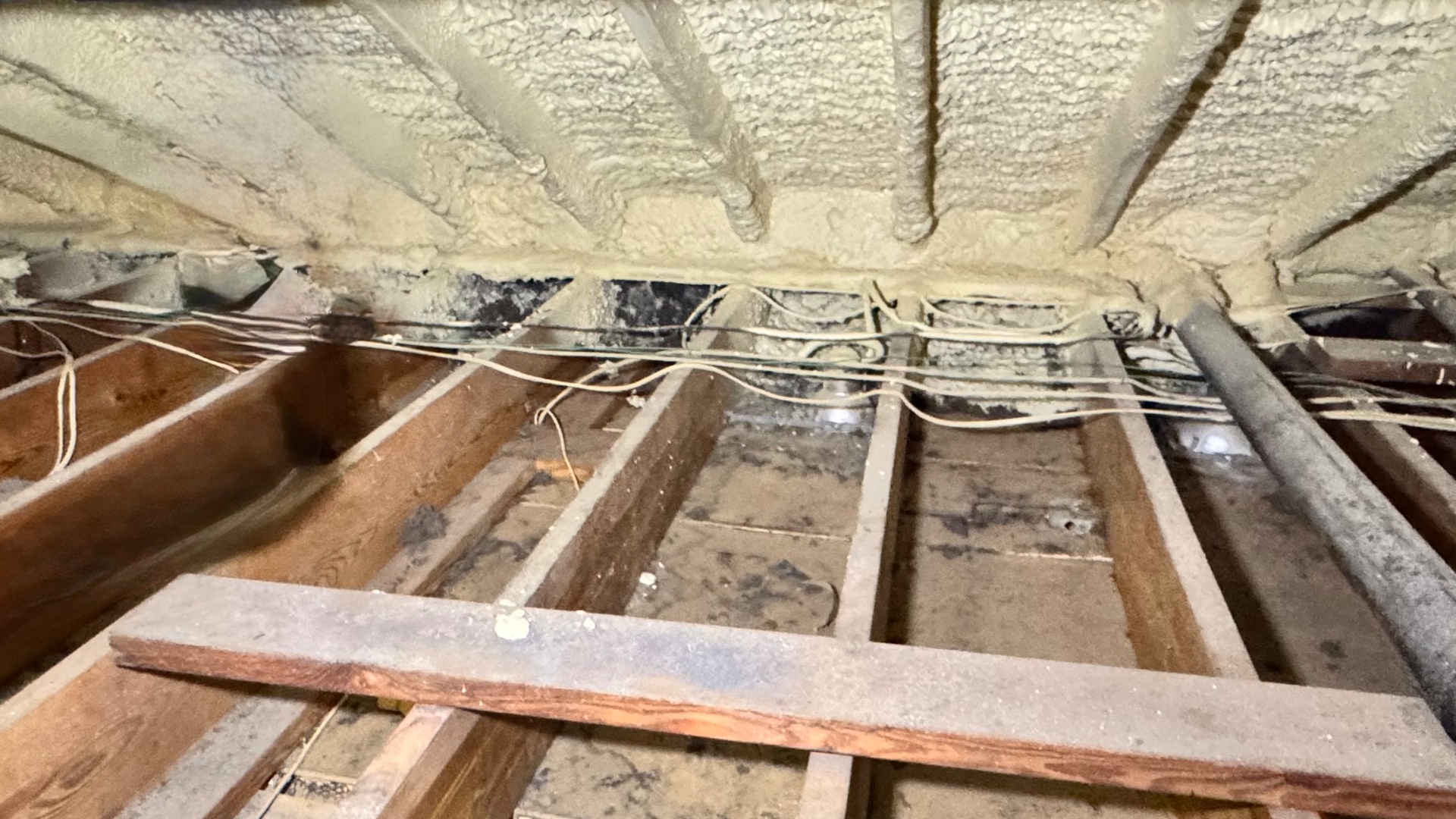
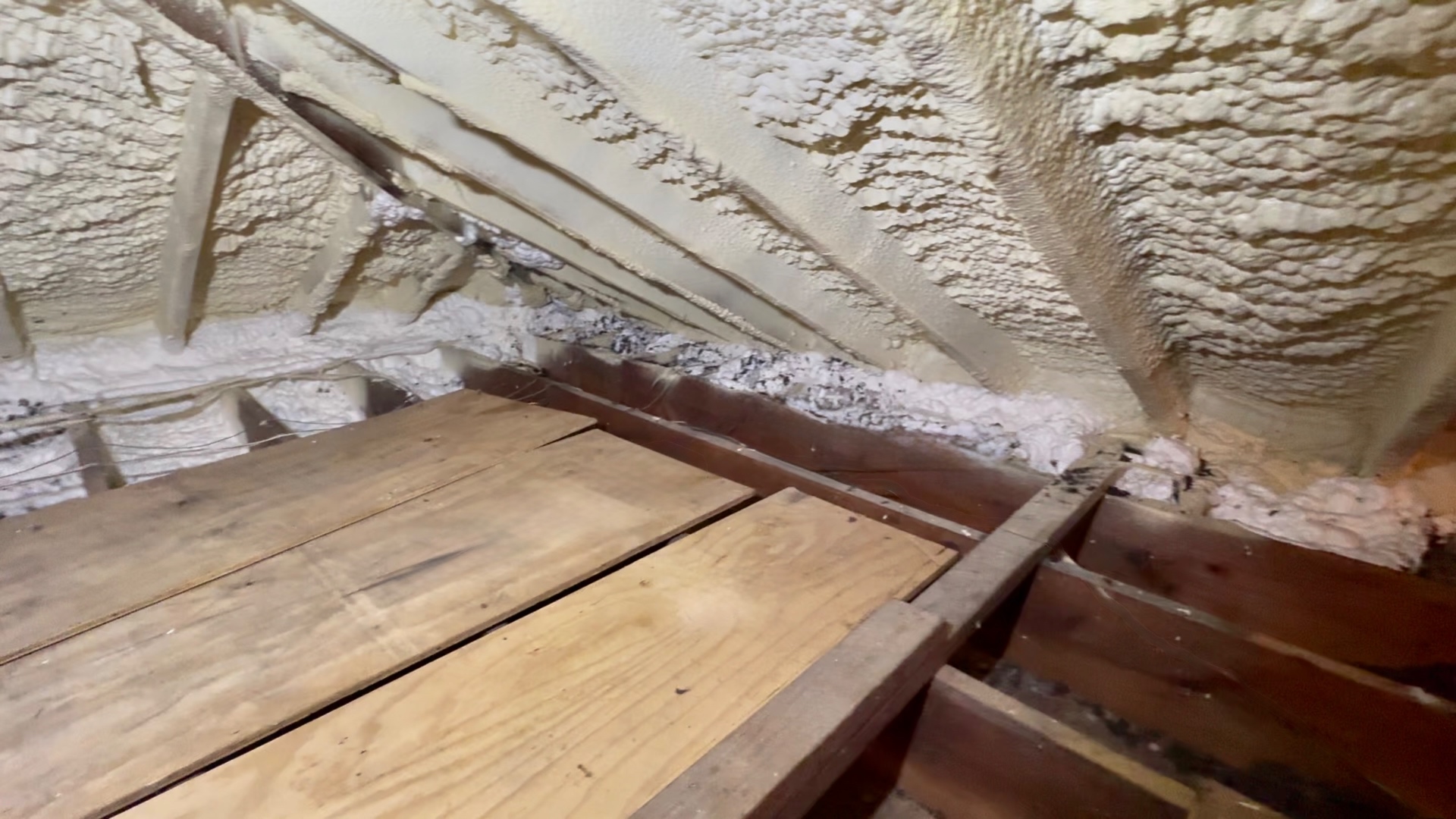
The perimeter problem was obvious the moment I walked into the attic. Closed-cell spray foam covered the roof deck, but the air seal was incomplete at the roof-to-wall connection. The insulation was visible. The continuity of the enclosure was missing.
That distinction drove the repair. Rather than ask another machine to manage the symptoms of an open perimeter, we addressed the opening and completed the existing supply-air distribution. In the weeks that followed, the ducts dried and second-floor conditions became more stable.
The short version
- Find the moisture pathway. Roofline foam does not, by itself, demonstrate that an attic has a continuous air barrier.
- Repair the identified defect. At this house, the priority was the exterior perimeter, followed by distribution of the conditioned air already being supplied.
- Watch what happens afterward. Monitoring covered a few weeks before the repair and a few weeks afterward. No dedicated dehumidifier was needed to achieve the observed result.
This is not an argument against dehumidifiers. It is an argument for establishing why one is needed before selling it as the next solution.
What the moisture looked like
The attic was warmer than I expected beneath a sealed, insulated roofline, but temperature was not the most pressing concern. Persistent humidity and condensation were affecting multiple cold components, not just a single isolated spot.
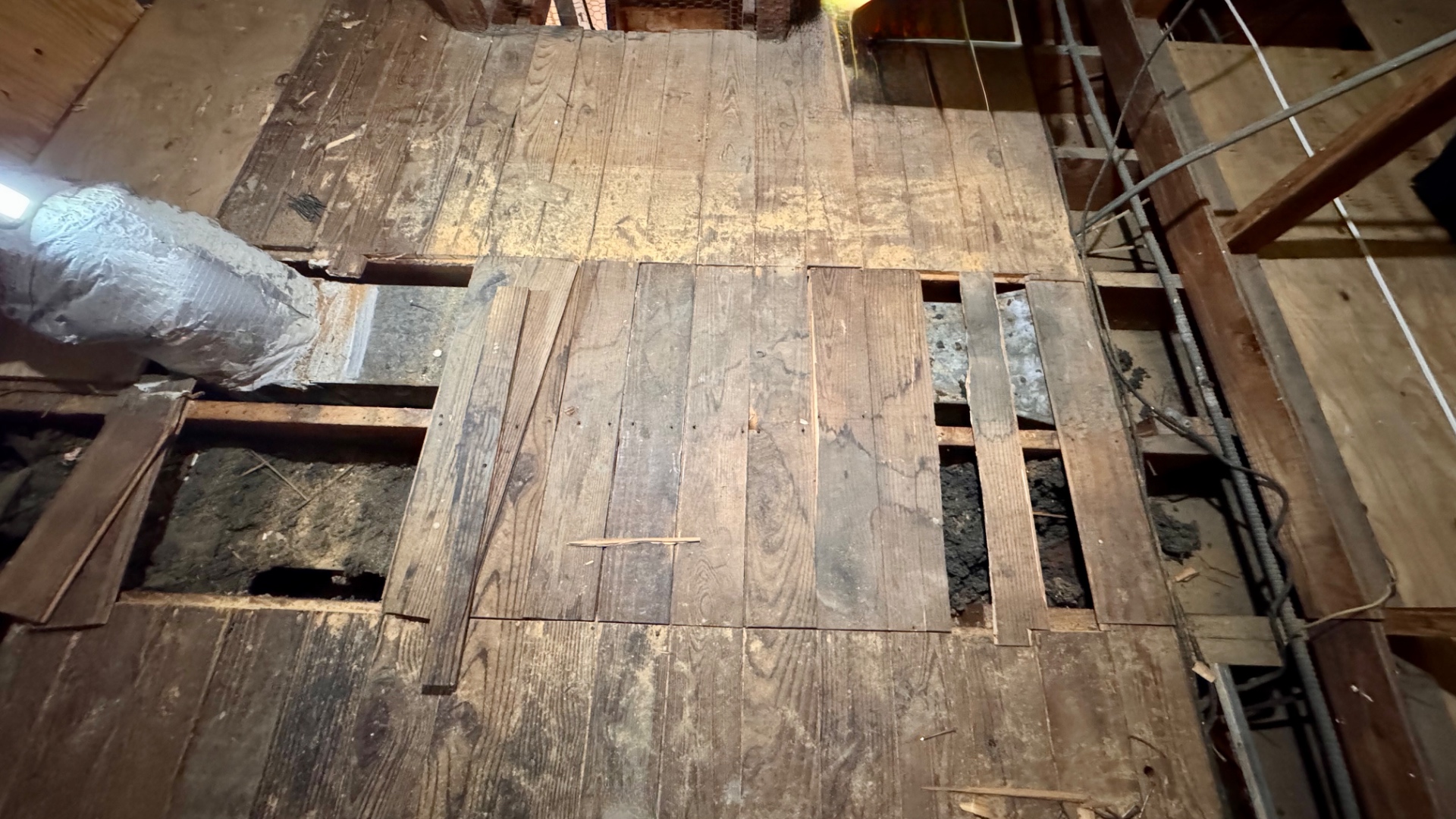
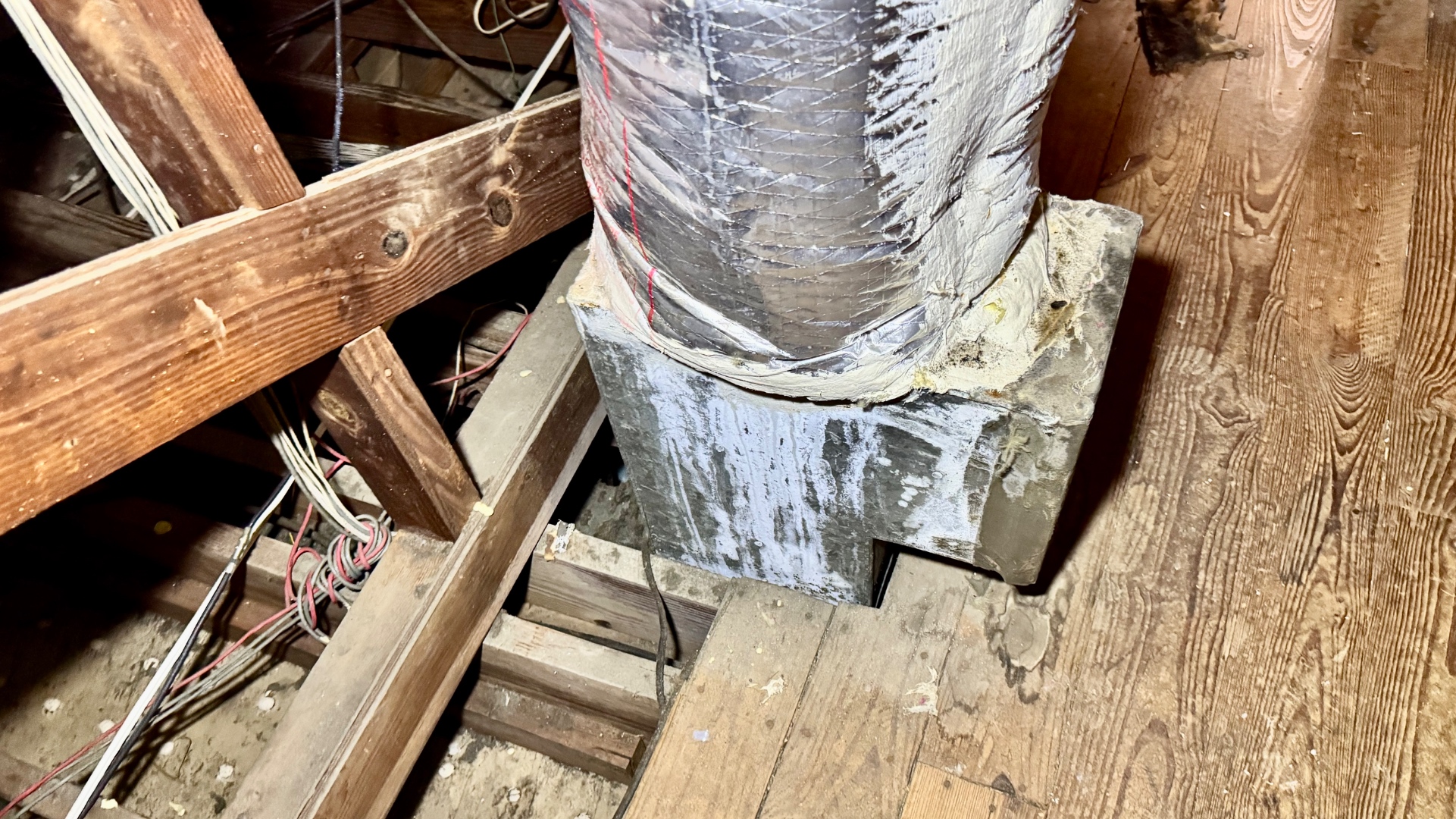
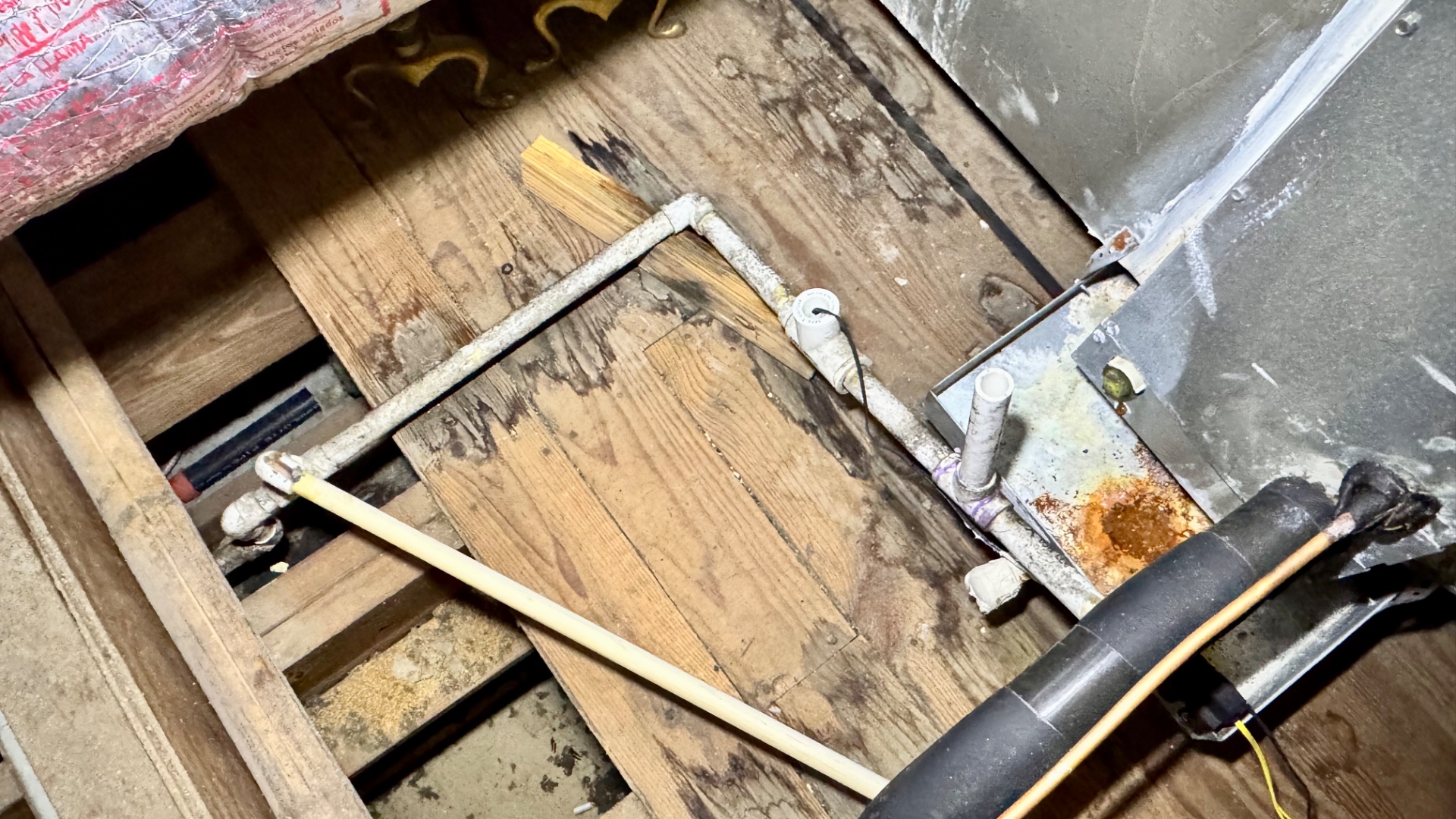
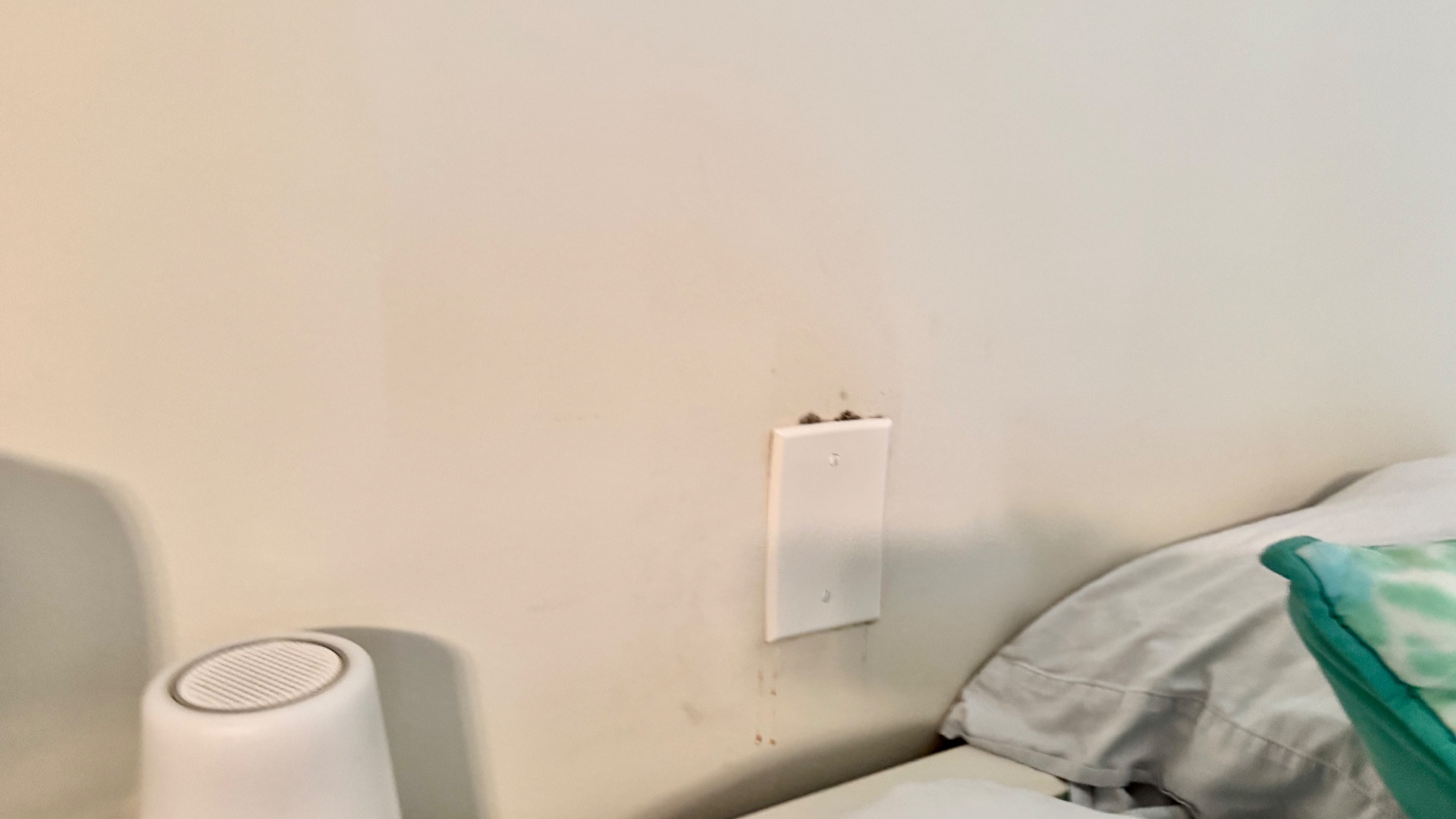
Repeated wetting can create conditions favorable to biological growth; this case documents moisture conditions, not a confirmed identification of mold or other organisms.1
The photographs establish where wetting was visible. They do not, on their own, measure air leakage, identify organisms, or prove the condition of concealed materials.
1. U.S. EPA, A Brief Guide to Mold, Moisture and Your Home, moisture-control guidance. https://www.epa.gov/mold/brief-guide-mold-moisture-and-your-home
A moisture problem, not simply a hot attic
A duct can sweat in an attic that does not feel especially hot. Condensation depends on whether the duct’s exterior surface is cold enough to reach the dew point of the surrounding air. Dew point describes the temperature at which that air becomes saturated; a higher dew point indicates more moisture in the air.2
That is why attic temperature alone is an incomplete diagnostic. A reasonably moderate temperature does not establish that the moisture level is low enough for exposed cold surfaces. Temperature, relative humidity, surface temperature, and the condition of the duct insulation all belong in the investigation.2, 1
In this house, the open perimeter was the conspicuous enclosure defect. My working diagnosis was that it allowed an avoidable moisture load into the attic and undermined the existing conditioning effort. The repair addressed that pathway rather than treating the foam-covered roof deck as proof that the enclosure was complete.
There is a broader basis for that concern. A Florida Solar Energy Center review notes that air leakage can make moisture control in unvented attics more difficult, and that using supplemental dehumidification in a poorly sealed attic may lead to much higher energy costs than expected.4
A useful distinction
A dehumidifier can remove water without fixing the source. Conventional self-contained refrigerant units discharge warmer, drier air. If that air is discharged into the attic, it adds heat there; if ducted into the home’s HVAC system, the warm discharge enters that system instead. The unit’s location alone does not tell us where its discharge heat goes.3 Separately, warming air alone lowers relative humidity without removing water.2
I would not claim that no machine could ever keep up with this attic. We did not measure the proposed unit’s capacity against a quantified moisture load. The defensible conclusion is simpler: the known enclosure defect needed attention before an additional permanent machine could be justified.
2. National Weather Service, Discussion on Humidity. https://www.weather.gov/lmk/humidity
1. U.S. EPA, condensation and moisture guidance. https://www.epa.gov/mold/brief-guide-mold-moisture-and-your-home
3. AprilAire, Model E080 & E100 Dehumidifier Installation Instructions, pp. 10–11, ducted versus stand-alone installations. Manufacturer manual hosted by Jackson Systems. https://jacksonsystems.com/wp-content/uploads/2024/07/Aprilaire_E100_Installation_Instructions.pdf
4. Florida Solar Energy Center, Review and Consider Possible Technical Changes to section 553.9065, Florida Statutes, revised Dec. 6, 2024, pp. 4, 47. https://www.floridabuilding.org/fbc/commission/FBC_1224/Review_and_Consider_Possible_Technical_Changes_to_section_553-9065_FS_Revised_120624_with-Data-revision1.pdf
Two months of monitoring, with the repair in the middle
On July 29, I installed three of my data loggers: two in the attic and one at the second-floor hallway thermostat. Before the repair, I also pressure-tested the house and ductwork to assess the house as a system, rather than diagnose the attic in isolation.
HALLWAY MONITORING · ORIGINAL RECORD
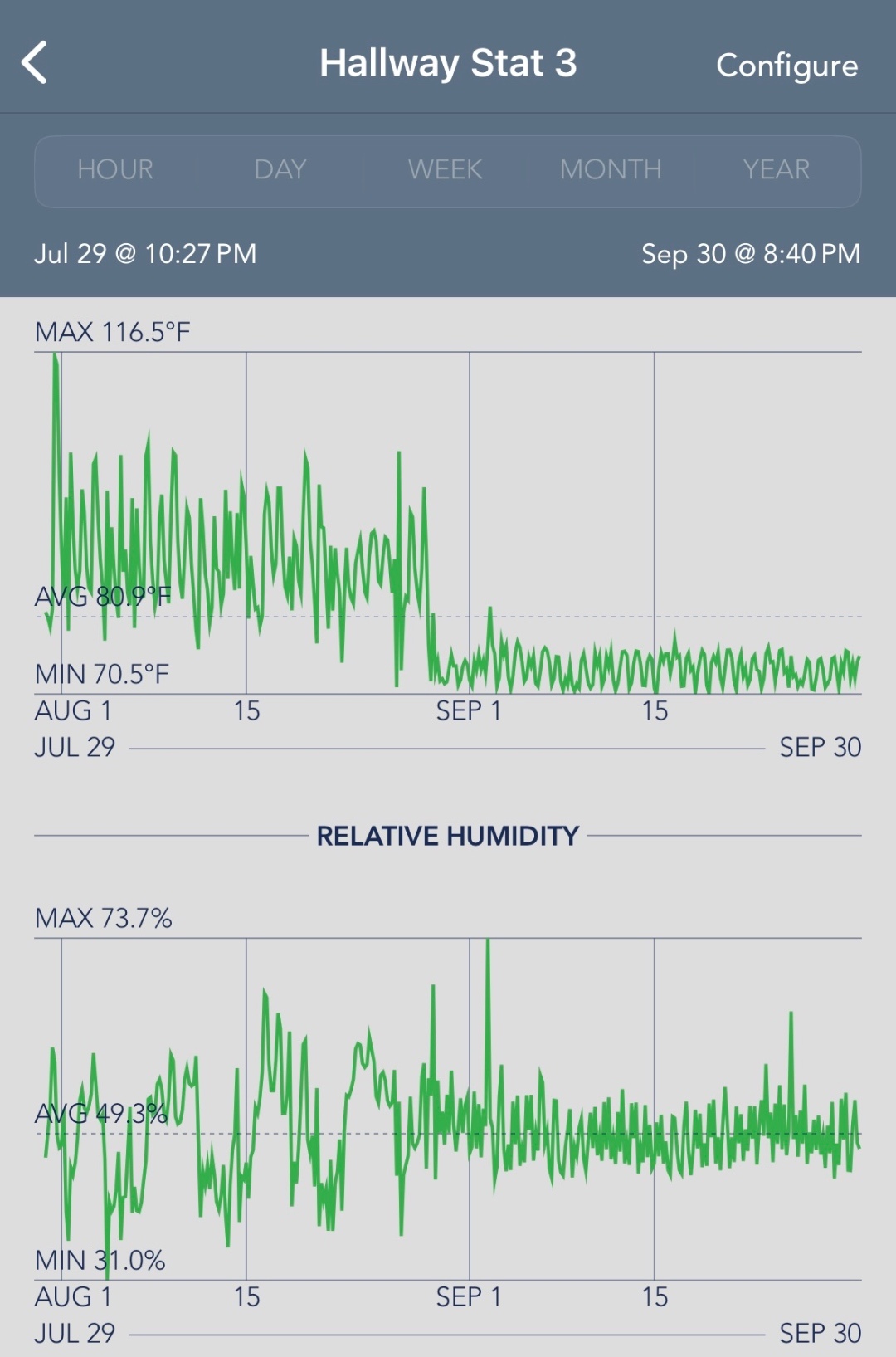
Late July to late August
The first month captured conditions before the perimeter repair, establishing a record for comparison with the follow-up period.
End of August
After several weeks of monitoring, we sealed the perimeter with foam and completed the supply-air ducting.
Through late September
The loggers continued collecting data for the following month. The record therefore spans both sides of the repair, not two months of baseline conditions.
What this display supports
The hallway temperature trace is visibly lower and steadier after the repair. The RH trace also appears less variable overall afterward.
Most importantly, the improvement was felt in the home, and the condensation stopped.
What the graph shows. This is the hallway record, not an attic humidity graph. Its summary statistics cover the full interval, not separate before-and-after periods. Attic drying was documented separately through field observations and photographs.
The repair: complete the boundary, then distribute the air
The scope centered on sealing the roof-to-wall perimeter with foam and completing the supply-air distribution. We did not add a dedicated dehumidifier. The repair cost was a fraction of the proposed equipment scope.
Close the perimeter
The primary work was at the transition the earlier installation had left open. The objective was a continuous connection between the roofline air-control layer and the exterior-wall boundary.
Redistribute the existing supply air
The original supply branch discharged locally. We used a wye arrangement to redistribute that air to three locations, including opposite ends of the attic. The added runs shown here were to be hung from the rafters.
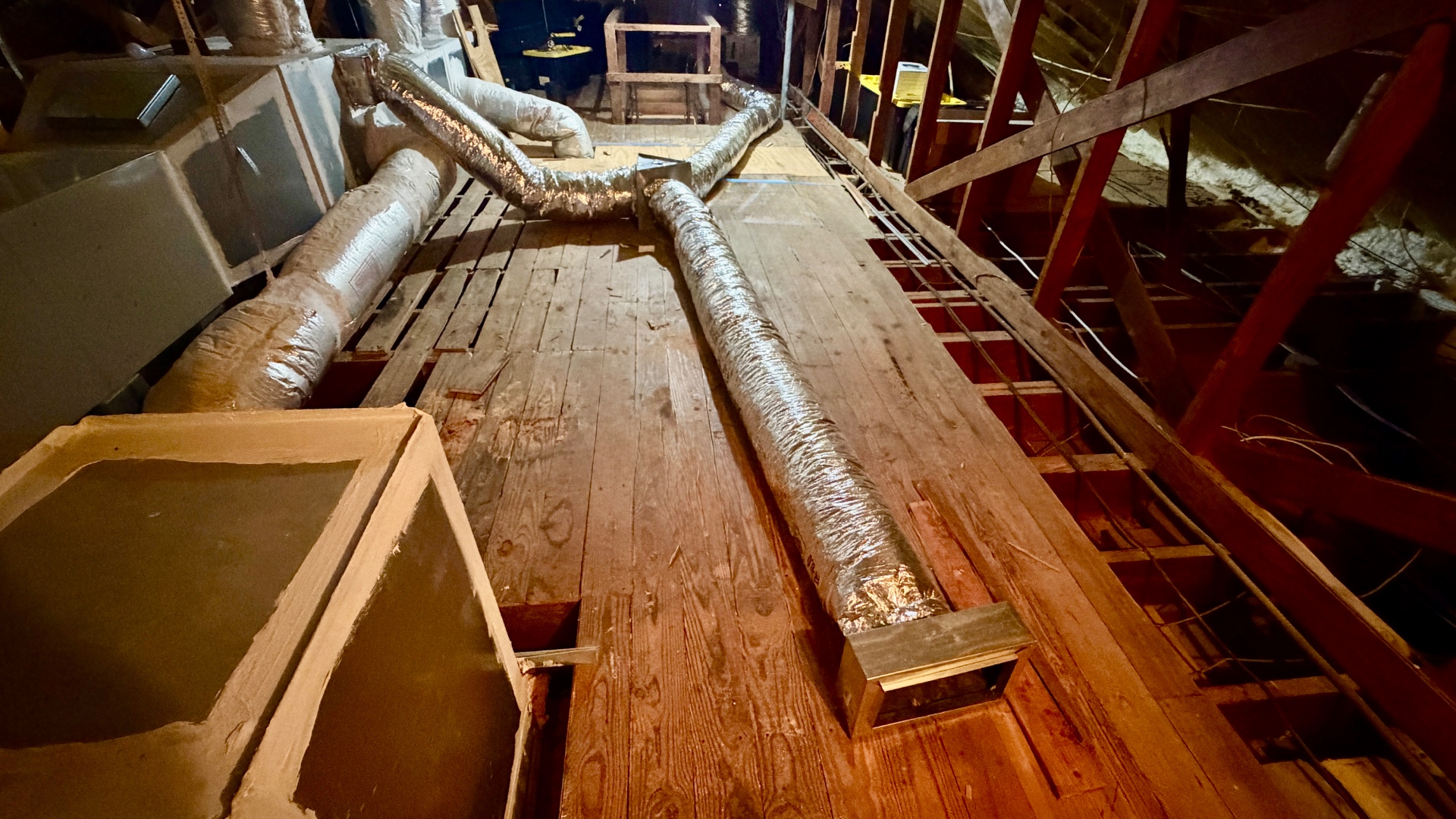
We also installed the filtered return-air grille. These changes were completed in the same repair period; the follow-up documents the combined result, not a separately measured contribution from each change.
What changed afterward
Over the following weeks, the visible condensation dried, the dripping into the home stopped, and second-floor comfort improved. The post-repair photographs show dry surfaces where the earlier inspection had documented widespread wetting. The hallway record provides a separate view of the more stable conditions during the follow-up period.
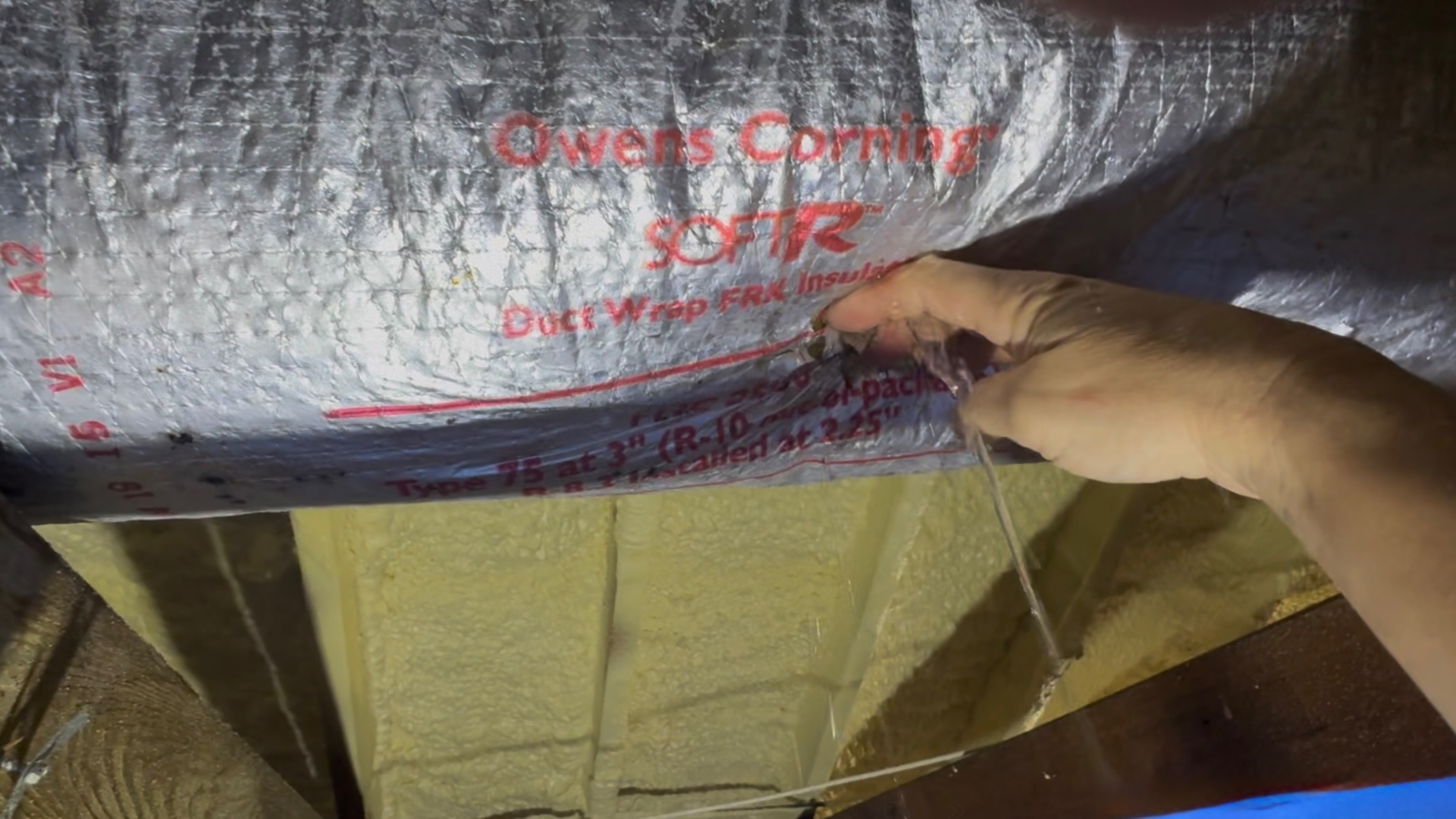
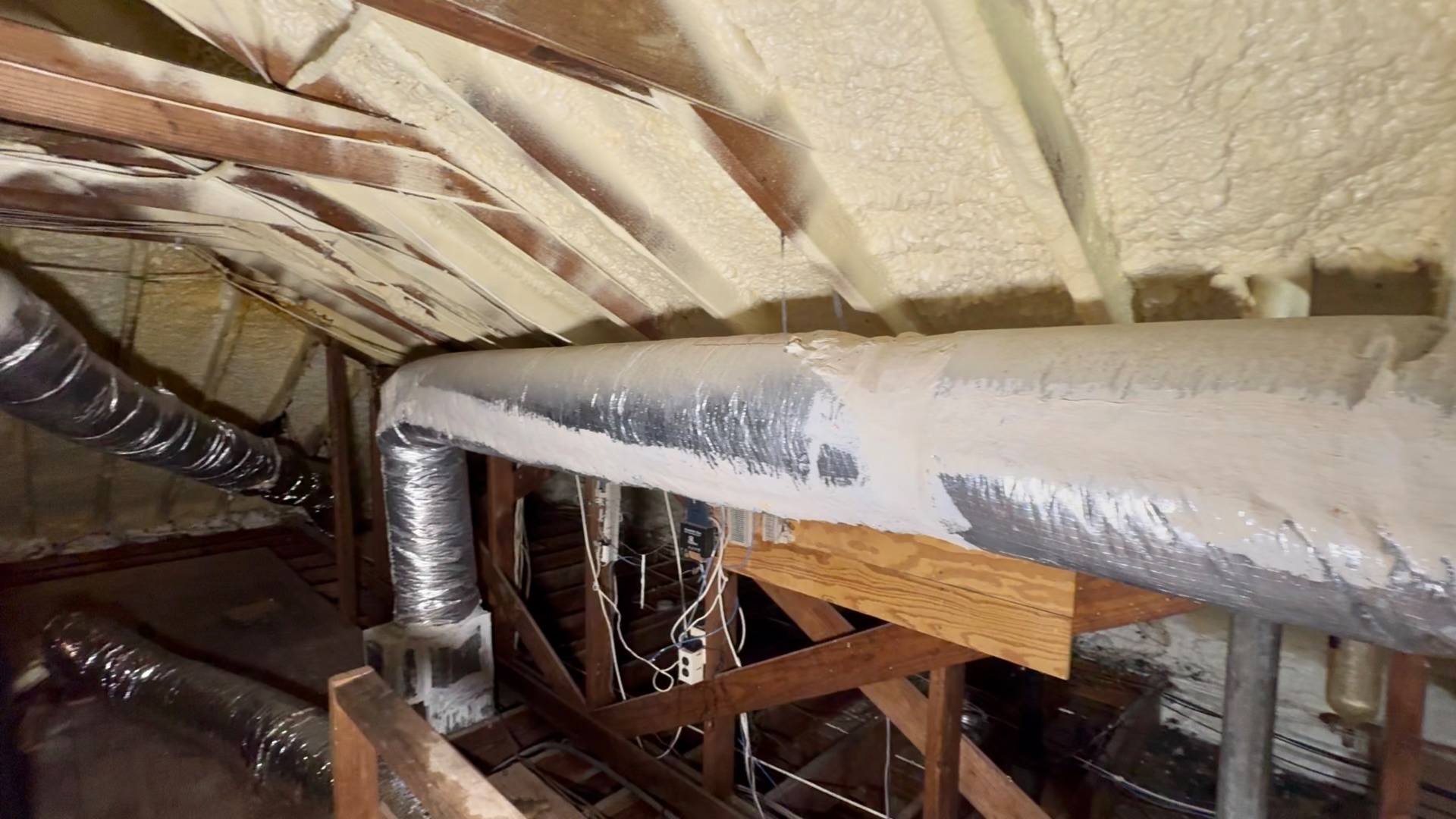
That outcome was enough to remove the need for the proposed dehumidifier on this job. It is not a guarantee against every future moisture problem, nor a claim that air sealing alone is sufficient for every unvented attic.
Two different scopes of work
| Question | Proposed equipment scope | Repair performed |
|---|---|---|
| Primary action | Add dedicated moisture-removal equipment. | Seal the perimeter, complete supply-air distribution, and install the filtered return-air grille. |
| Known enclosure defect | Adding a machine would not itself close it. | The defect was directly addressed. |
| Cost in this case | More than $20,000 quoted, with additional maintenance. | A fraction of that proposed scope; no added dehumidifier. |
| Evidence of performance | Not installed, so no performance result is claimed. | Dry follow-up observations and a steadier hallway record. |
The distinction is not that one approach uses machinery and the other does not. The existing air conditioner remained part of the solution. The distinction is whether the avoidable load was investigated before more equipment was proposed.
What the code says, and what it does not
Code language and field recommendations are not interchangeable. Three distinctions matter here.
Distinguish the model code from Louisiana’s amendments
The unamended 2021 model-code table calls for a continuous air barrier with breaks and joints sealed.5 Louisiana repeals the installation section R402.4.1.1, so that model-code language should not be presented as an unchanged Louisiana requirement.6
Louisiana’s roofline-conversion amendment does require appropriate HVAC sizing or modification, removal of insulation between the sealed, conditioned attic and living space, and blocking and sealing outside attic-ventilation openings. It includes a limited exception for space under approved appliances: that space must be sealed from the attic and occupy less than 10% of the conditioned attic floor.6 These provisions reinforce the need to address the perimeter, not just insulate the roof deck.
Attic supply air is not a blanket spray-foam requirement
The 2021 IRC R806.5, Item 5.2.10, calls for at least 50 cfm per 1,000 square feet of ceiling area within its provisions for certain air-permeable insulation assemblies in Climate Zones 1, 2, and 3. It is not a universal requirement for attics insulated with air-impermeable spray foam.7 The supply-air work here was part of this repair strategy, not a prescription for every foamed attic.
Foam thickness is a separate question
Foam thickness alone does not establish its installed R-value, its product-specific air-barrier qualification, or the assembly’s energy-code compliance. Product documentation, actual coverage, the applicable code, and the compliance path must be checked.5 This case does not establish that the entire original insulation assembly complied.
Louisiana context. DOE identifies Louisiana’s current energy code as the 2021 IECC with amendments; Louisiana’s administrative code assigns the state to Climate Zone 2A for energy purposes.8, 6 This is a technical explanation, not a retrospective compliance finding for the original installation.
5. ICC, 2021 IRC, Table N1102.4.1.1 (R402.4.1.1) and N1101.10.1 (R303.1.1), model-code air sealing and insulation documentation. https://codes.iccsafe.org/content/IRC2021P1/chapter-11-re-energy-efficiency
6. Louisiana Division of Administration, Title 17, Construction, May 2026 compilation, § I-117: R301.1, R402.2.1 and repeal of R402.4.1.1. https://www.doa.la.gov/media/rsxerapb/17.docx
7. ICC, 2021 IRC, R806.5, Items 5.1–5.2.10 and exceptions. https://codes.iccsafe.org/s/IRC2021P2/part-iii-building-planning-and-construction/IRC2021P2-Pt03-Ch08-SecR806.5
8. U.S. DOE, Louisiana: Building Energy Codes Program. https://www.energycodes.gov/status/states/louisiana
Best practice starts with a working enclosure
LSU AgCenter’s educational guidance emphasizes sealed roof-to-wall blocking, airtightness testing for attic conversions, and air-conditioning connections for warm-climate humidity control.9 Building Science Corporation also emphasizes moisture removal, but describes a different air-change strategy.10 These are design recommendations, not one universal duct layout or a substitute for current code.
The original conditioning approach might have worked had the boundary been complete. In this case, the completed repair was followed by dry ductwork and improved comfort without the proposed additional machine.
Before approving the next equipment quote
- Identify the moisture pathway. The diagnosis should explain likely sources, not stop at a high humidity reading.
- Check the enclosure. Have a qualified professional inspect the boundaries, using pressure testing where appropriate.
- Evaluate the existing system. Review duct leakage, insulation, airflow, controls, and safe equipment operation.
- Verify the result. Monitor after the repair. If humidity remains excessive, evaluate the remaining load before selecting supplemental equipment.
A house works as a system. Diagnose it that way before deciding what to repair or replace.
At Practical Home Performance, we consider how the enclosure, insulation, ductwork, equipment, and indoor conditions interact. A symptom in one room may begin elsewhere. The right repair addresses that connection rather than assuming another machine will solve it.
Urgent drying should not wait for a longer-term repair.1 But permanent supplemental equipment should not substitute for correcting an identified enclosure failure.
Project observations, sequence, costs, and photographs: Jeff Haag. References support the technical explanation, not independent verification of this property’s performance.
9. Claudette Hanks Reichel, LSU AgCenter, Insights on Spray Foam, Unvented Attics, HVAC and Moisture, “Requirements & Recommendations” and conversion guidance. https://www.lsuagcenter.com/nr/rdonlyres/a787749c-0a32-4595-bf30-8b05d548518f/96454/sprayfoamatticshvacandmoisture.pdf
10. Joseph Lstiburek, Building Science Corporation, GM-2102: Residential Spray Foam Guide, roof moisture-removal discussion. https://www.buildingscience.com/documents/guides-and-manuals/gm-2102-residential-spray-foam-guide
1. U.S. EPA, prompt drying and moisture control. https://www.epa.gov/mold/brief-guide-mold-moisture-and-your-home